Agent Skills 2026: Claude, ChatGPT & Cursor Open Standard Explained
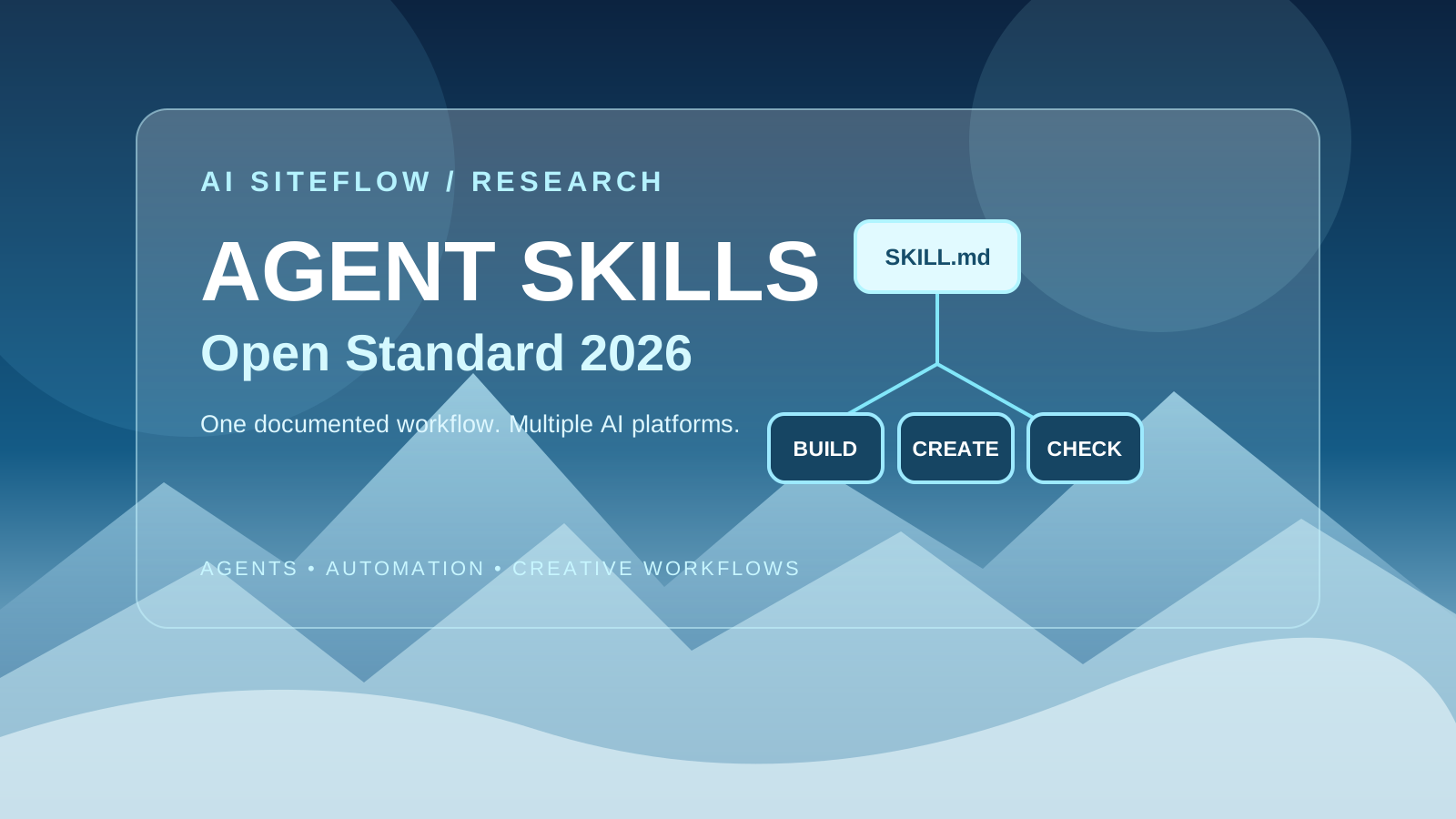
On October 22, 2026, Anthropic announced that it was donating Agent Skills to the Agentic AI Foundation (AAIF). The news matters well beyond Claude: according to Anthropic, more than 70 agent platforms have integrated the format, including ChatGPT, Cursor, GitHub Copilot and Visual Studio Code. For businesses building AI workflows, the bigger story is not another chatbot feature. It is the possibility of turning operational know-how into reusable, more portable instructions.
Quick answer: Agent Skills is an open format for packaging task instructions and supporting resources in a folder containing a SKILL.md file. It can teach compatible AI agents how to handle a repeatable workflow. It does not automatically connect to your accounts, guarantee identical behavior on every platform, or replace human review. The October 2026 announcement moves governance of the format to the AAIF under the Linux Foundation.
What happened on October 22, 2026?
Anthropic said it was contributing the Agent Skills specification, name, logo, GitHub organization and agentskills.io domain to the Agentic AI Foundation. The foundation is intended to provide a neutral, community-led home for the standard rather than leaving its direction entirely with one vendor. Anthropic says engineers from Anthropic, Google, OpenAI and other organizations will help maintain it as individuals.
The announcement included two notable adoption figures: more than one million published skills and nearly 280 million installations, according to Anthropic and the AAIF. Those are ecosystem-reported figures, not independently verified counts of active business users or successful automations. The companies also reported integration in more than 70 agent platforms. The distinction matters: a platform integrating the format does not mean every installation or capability works identically in every product or account.
In the same week, the AAIF announced other incoming projects, including Open Responses, OpenEnv and OpenSandbox. Together these represent different parts of agent infrastructure: connecting applications to models, training and evaluation environments, secure execution, and reusable procedural knowledge. Agent Skills addresses the last of these problems.
What exactly is an Agent Skill?
Imagine an agency repeatedly producing short-form advertisements. Every project needs a brief, verified brand assets, a shot list, prompt variations, an editorial check and a delivery checklist. A general-purpose assistant can help with those steps, but different team members may explain the process differently. A skill stores the repeatable method in a form the agent can read when needed.
According to the official specification, a skill is a directory containing a required SKILL.md file. That document begins with YAML frontmatter, including a required name and description, followed by task instructions. A skill may also contain optional scripts/, references/ and assets/ directories. The format supports progressive disclosure: a tool can learn that a skill exists from its metadata, then load detailed instructions and references when relevant.
Think of it as a documented operating procedure for an AI agent. It is not a magical model upgrade or a replacement for software engineering. It makes expertise easier to package, review and reuse.
Why an open standard matters for Claude, ChatGPT and Cursor
When a company invests time in teaching one assistant an internal workflow, moving to a different tool can be expensive. Prompts are buried in chats, documents are scattered across folders, and practical knowledge depends on the person who originally wrote the instructions. An open skill format offers a possible way to preserve that know-how across compatible tools.
For example, a creative studio could maintain a documented process for checking a commercial script. One coding assistant might invoke the skill while updating a video landing page; another could consult the same guidance during content preparation. The shared asset is the procedure, not the underlying model. Each agent still brings its own tools, permission boundaries, context window, limitations and product-specific integrations.
That qualification is important. Anthropic's announcement says these major products have integrated the standard; it does not establish that one skill will run without modification in every environment. Always verify tool support, file placement, permissions and actual results in the target application.
Agent Skills vs MCP vs AGENTS.md: the useful distinction
Several AI-agent technologies are often mentioned together, but they solve different problems. A quick conceptual comparison helps teams choose the right building block.
| Technology | Primary role | Practical example |
|---|---|---|
| Agent Skills | Reusable task instructions and resources | A review checklist for a commercial storyboard |
| MCP | A protocol connecting AI applications with tools and data | Permitting an agent to read an approved project system |
| AGENTS.md | Repository-level guidance for coding agents | Documenting build commands and code conventions |
| Application automation | The actual workflow, permissions and execution logic | Creating a draft, requesting approval and recording status |
These layers can complement each other. An Agent Skill can instruct a workflow to check a product claim against approved source files. A tool integration can provide access to those approved files. A review process can prevent publication until someone signs off. None of these components should be confused with an automatic guarantee of correctness.
How to write your first Agent Skill: a real example
Here is a small, illustrative skill for an agency that reviews proposed commercial videos. It intentionally stops short of sending messages or publishing anything. Start with a folder named commercial-brief-review, and create a SKILL.md file inside it.
---
name: commercial-brief-review
description: Review commercial-video briefs for approved facts, shot structure, and disclosure needs. Use before a storyboard is approved.
---

# Commercial brief review

## Inputs
- Client-approved brand brief
- Approved product or property facts
- Proposed script and shot list
- Intended platform and duration

## Steps
1. Separate verified claims from creative concepts.
2. Check the opening hook and intended audience.
3. Verify visual and voiceover claims against approved inputs.
4. Flag invented amenities, prices, guarantees or specifications.
5. Check framing, aspect ratio and a clear call to action.
6. Return a review table: issue, evidence, suggested fix.

## Safety
- Never claim fictional AI-generated property visuals are real footage.
- Never invent product features or testimonials.
- Do not publish or contact a client without approval.
- Mark unknown details as unverified.

## Output
- A concise approval checklist
- Revised script suggestions
- Open questions for a human reviewer
The folder and frontmatter above follow the core specification structure. Compatibility, installation location and invocation behavior still depend on the agent product. Before using the skill in production, validate the folder using the specification's reference tooling, test it with representative examples, and document expected outputs.
The key lesson is that specific instructions beat vague requests. “Make my ad better” is difficult to review. “List unsupported claims, missing references and the precise change required” produces a more actionable result.
Use case 1: a repeatable AI commercial production workflow
For an AI-video agency, quality problems often occur between tools, not inside a single model. The storyboard calls for one property style, the image reference shows another, and the final clip contains a feature the client never approved. Agent Skills can encode pre-production and quality-control procedures so the team works from a shared checklist.
A studio could create separate skills for creative-brief intake, storyboard review, brand-safety checks and delivery packaging. The human producer should still approve claims, likeness rights, commercial-use permissions and the final edit. Skills help standardize work; they do not turn a fictional render into verified footage.
Useful deliverables include a one-page shot list, asset manifest, continuity checklist and final export requirements. Linking them back to the approved client brief makes revisions faster and disputes less likely.
Use case 2: more reliable AI website builds
Website development involves dozens of recurring checks: semantic headings, accessibility, responsive behavior, asset sizes, metadata, internal links, route status and production builds. A coding agent may generate a beautiful page and still overlook a broken route or inaccurate marketing claim. A development skill can make those checks explicit.
For example, a landing-page-qa skill could tell an assistant to inspect the changed files, review every new link, run the project build, confirm image paths exist, test mobile layouts and summarize unresolved risks. A separate deployment workflow should control when code reaches production. In team environments, branching and pull requests help prevent one person from overwriting another's work.
These checks matter more than promising perfect Lighthouse scores or guaranteed conversions. A well-reviewed page still requires real testing on representative devices and monitoring after launch.
Use case 3: client research and responsible outreach
A useful sales skill can define what makes a prospect relevant: industry, geography, apparent advertising needs, publicly verifiable business details and a plausible creative angle. It can also instruct the assistant to write a concise, personalized draft referencing the prospect's publicly available work.
But a skill is not permission to mass-message strangers, scrape restricted data or invent a relationship. Teams should review contact details, comply with platform rules and applicable marketing requirements, and send only approved communications. For an agency, a smaller number of relevant conversations can be more useful than a huge volume of generic messages.
Use case 4: SEO articles that go beyond recycled news
AI tools make it easy to generate thousands of similar articles. That does not mean such content provides value. A research skill can require the author to verify the announcement date, link to the original vendor source, separate established facts from forecasts and add an original implementation example relevant to a specific audience.
For a creative-tech company, a useful post should answer a practical question: What changed? Who can use it? What should an agency test? What is still uncertain? This approach may improve usefulness and trust, but it does not guarantee Google rankings or traffic. Search visibility depends on many factors outside a writer's control.
What businesses should test before adopting Agent Skills
- Choose one repeated workflow. Pick a task with clear inputs, measurable output and frequent human repetition. Avoid automating an entire company on day one.
- Write a factual reference. Define trusted inputs, examples, exclusions and an owner responsible for updating the instructions.
- Limit permissions. A skill that tells an agent what to do is different from permission to run scripts, use credentials or change customer records. Grant only the access the task needs.
- Test difficult cases. Include missing assets, ambiguous requests, outdated prices and conflicting instructions. An agent that succeeds only on the perfect sample is not ready for production.
- Measure the right result. Track review accuracy, rework and time saved rather than the number of tokens produced. Record where a human corrected the output.
- Review before deploying widely. Maintain changes in version control, require appropriate approvals and preserve an easy rollback path.
Security deserves special attention. Skills can contain instructions, references and optional executable scripts. Only install skills from sources you trust; inspect scripts and links; and test behavior in a limited environment. Treat third-party text as potentially untrusted input, especially when agents also have access to powerful tools.
Do Agent Skills mean AI agents can run a business by themselves?
No. Reusable instructions improve consistency, but operating a real business still requires judgment, verified data, contracts, budgets, customer service and secure software. A company cannot replace those responsibilities with a SKILL.md file. More capable agents might complete more multi-step work in future, but the October 22 announcement is about the governance and portability of a format, not proof of fully autonomous businesses.
The most practical near-term opportunity is narrower and more useful: create dependable workflows for routine work, then keep humans responsible for material decisions and outcomes.
Frequently asked questions
Is Agent Skills a new AI model?
No. It is an open format for instructions and related resources that compatible AI agents can load. It does not train a new foundation model.
Does a Claude skill automatically work in ChatGPT or Cursor?
Not necessarily. Several major platforms support the standard, but loading rules, compatible tools, permission models and capabilities can differ. Test the skill in the exact environment you plan to use.
Is Agent Skills the same thing as MCP?
No. Agent Skills packages procedural know-how; MCP provides a standardized way for AI applications to interact with tools and data. They address different layers of the stack.
Do businesses need programmers to start?
A simple instruction-only skill can be drafted without complex programming. Installing it, integrating external tools, maintaining it and securing production workflows may require technical help.
Are Agent Skills safe to install?
Safety depends on the source, content, tools, scripts and granted permissions. Review untrusted skills carefully and avoid granting unnecessary access.
Will this technology replace creative agencies?
Agent Skills can reduce repetitive procedural work, but differentiation still comes from strategy, design decisions, verified messaging, production quality, customer relationships and delivery. The impact will vary by company.
The AI SiteFlow perspective: build systems, not just prompts
For businesses commissioning AI commercials or modern websites, the real opportunity is a process that connects creative execution with consistent review. Better inputs, approved references and repeatable quality checks can make AI-assisted projects easier to manage. That is why the open Agent Skills development is worth watching even if a company does not write its first skill today.
At AI SiteFlow's commercial portfolio, our focus is the combination of visual storytelling and practical digital production. We also build modern websites and explore tools that can make repeatable work more reliable. The examples in this article are instructional frameworks, not claims that every workflow described has been deployed or benchmarked by our studio.
Bottom line: Anthropic's October 22 donation is an important ecosystem announcement. If open standards help businesses carry useful procedures between compatible tools, the best investment today is documenting how work should be done, testing workflows carefully and keeping human approvals where they matter.
Official sources and further reading
- Anthropic — Donating Agent Skills to the Agentic AI Foundation (October 22, 2026)
- Agentic AI Foundation — Four new projects announcement (October 22, 2026)
- Agentic AI Foundation — Sharing team expertise across AI agents (October 22, 2026)
- Agent Skills — Official format specification
- Google Search Central — Creating helpful, reliable, people-first content
Editorial note: News facts and ecosystem metrics above are attributed to the published vendor and foundation announcements. Workflow examples are AI SiteFlow editorial illustrations, not evidence of measured client results. Information reviewed October 25, 2026.