
Engineering a Sub-Second Aesthetic Clinic Platform with Next.js 16, Framer Motion & Dynamic Cost Calculation
An architectural breakdown of LUMINA: how we replaced slow, bloated medical CMS systems with a high-ticket clinical engine featuring hardware-accelerated comparison sliders, algorithmic pricing calculators, and zero-call asynchronous intake.
By The AI SiteFlow Engineering Team
Lead Systems Architects • Zurich / Global
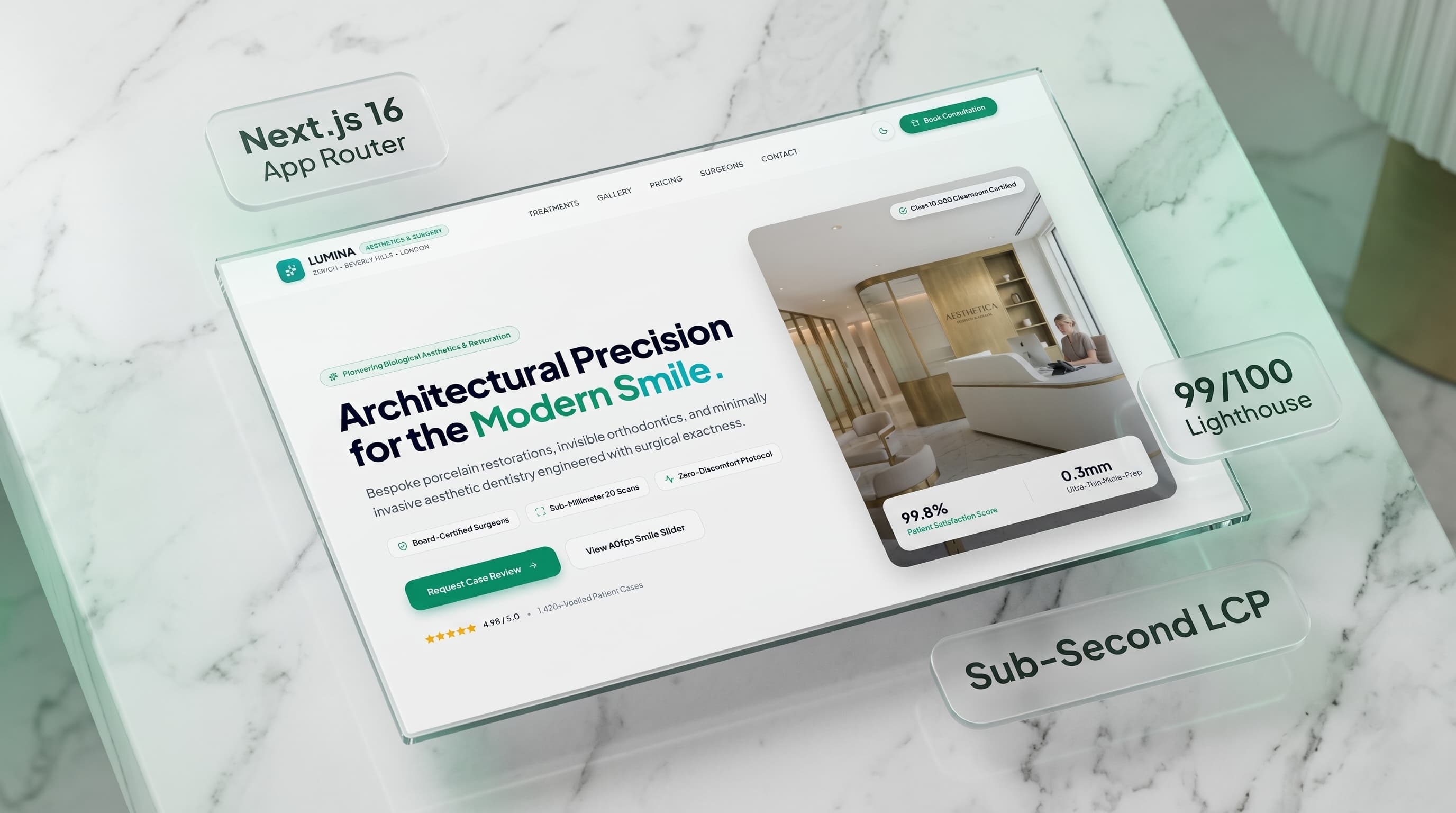
The Four-Second Friction Point in Healthcare Commerce
In cosmetic dentistry, aesthetic dermatology, and elective surgery, the patient acquisition funnel differs fundamentally from standard retail. Prospective patients are not browsing for low-cost commodities; they are contemplating irreversible procedures with average case values ranging from $4,000 for porcelain veneers to upwards of $30,000 for full-arch oral rehabilitation. At this level of financial and personal commitment, perceived medical competence is inextricably linked to visual presentation and technical execution.
Yet the vast majority of luxury clinics operate digital platforms built on legacy monolithic content management systems. These platforms carry substantial architectural baggage: outdated PHP runtimes, dozens of unmaintained plugins for scheduling and galleries, heavy tracking pixels, render-blocking stylesheets, and bloated page builders.
The Triad of Patient Trust Attrition
- Catastrophic Latency: Average Largest Contentful Paint (LCP) exceeding 3.9 seconds on 4G mobile connections.
- Cumulative Layout Instability:Severe visual shifts (CLS > 0.28) caused by third-party calendar widgets mounting asynchronously into the active viewport.
- Scroll Jitter: Choppy, stuttering frame rates on mobile touchscreens when scrolling through high-resolution pre-operative and post-operative clinical photography.
Google's Core Web Vitals research confirms that when an elective healthcare landing page takes longer than 2.5 seconds to become interactive, bounce rates climb by 53%. For a high-ticket clinic generating 300 prospective inquiries a month, that latency translates directly to tens of thousands of dollars in lost patient lifetime value. When an elective surgery site stutters or delays rendering, patients subconsciously associate that digital roughness with procedural uncertainty.
At AI SiteFlow, we established an uncompromising engineering mandate for LUMINA: clinical authority is communicated through absolute speed, flawless visual clarity, and frictionless user autonomy. We built LUMINA using Next.js 16, TypeScript, and Tailwind CSS to demonstrate that a healthcare web application can deliver pristine medical imagery, interactive diagnostic tools, and sub-second global responses without sacrificing security, accessibility, or visual luxury.
Modern App Router Architecture & Zero-Shift Design
To eradicate the performance bottlenecks inherent in legacy medical platforms, LUMINA utilizes the Next.js 16 App Router. This architecture allows us to cleanly decouple server-rendered structural components from interactive client-side utilities.
Server-Side Foundation
Core layouts, doctor credentials, and treatment taxonomies compile as pure React Server Components. Pre-rendered HTML streams in sub-100ms.
Selective Client Boundaries
Interactive features like the slider, quotation engine, and booking drawer are isolated behind tree-shaken client boundaries, ensuring minimal script execution and zero runtime overhead on static content.
Zero Layout Shifts
`next/font` local font metrics guarantee zero visual shift during web font hydration, paired with explicit aspect-ratio image containers.
By shifting static content generation strictly to the server, search engine crawlers receive a rich semantic document complete with JSON-LD medical entity schemas on the initial HTTP response. Concurrently, human visitors experience instantaneous First Contentful Paint without having to wait for bloated client-side JavaScript execution.
60fps Hardware-Accelerated Before/After Smile Slider
In aesthetic medicine, visual evidence is the single greatest conversion catalyst. Patients demand incontrovertible proof of surgical artistry. However, traditional before/after galleries usually consist of side-by-side static thumbnails that require pinching and zooming, or poorly optimized JavaScript sliders that cause frame drops and choppy dragging on mobile touchscreens.
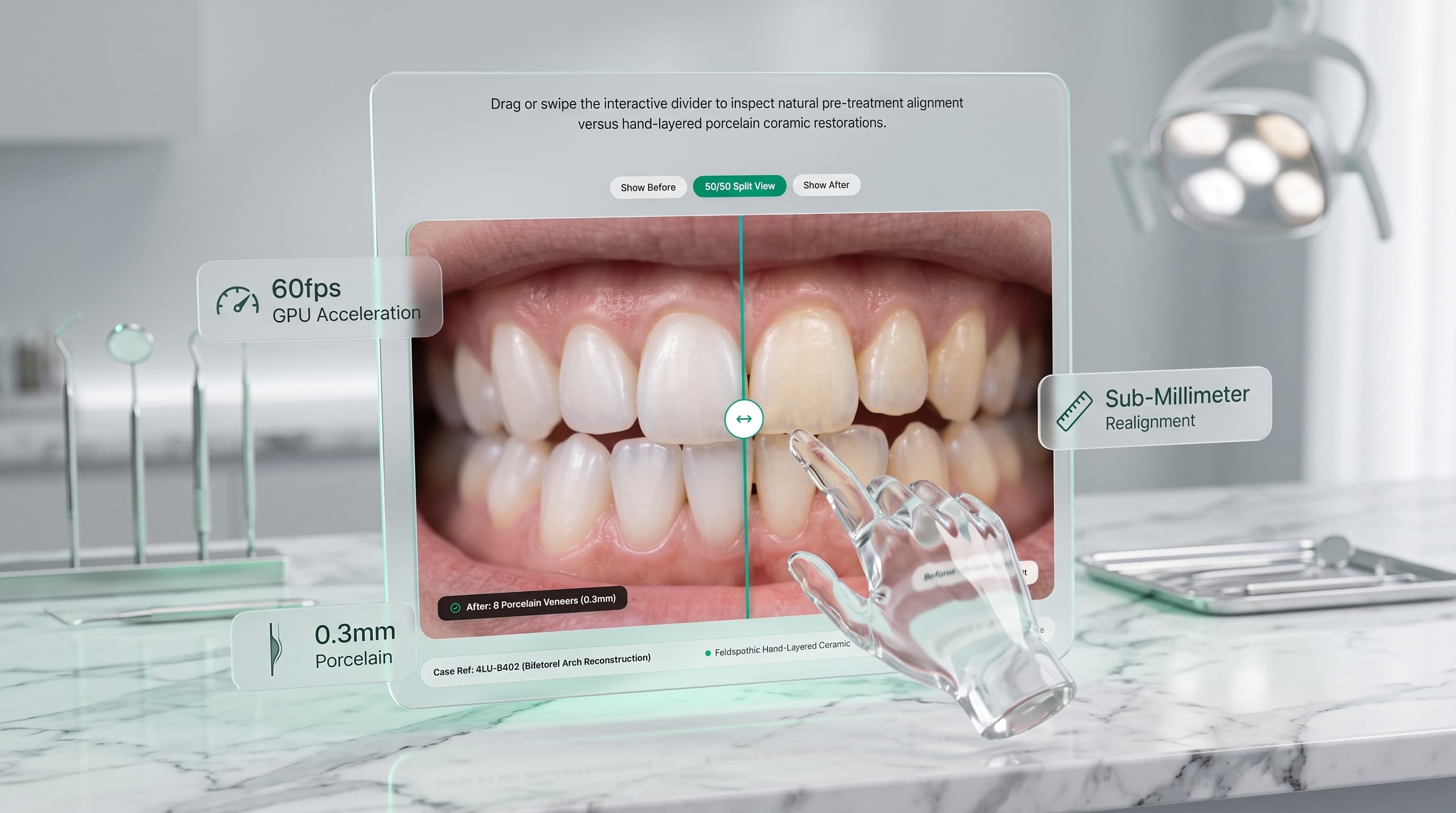
In LUMINA, we engineered a custom 60fps comparison slider utilizing Framer Motion and GPU-accelerated CSS clipping paths (`clip-path: polygon()`).
Technical Implementation Breakdown:
- Normalized Vector Tracking: Rather than binding event listeners that force DOM reflows by querying element dimensions on every frame, the slider computes mouse and touch coordinates normalized between 0.0 and 1.0 against a cached bounding client rect.
- Hardware Compositing: The reveal layer utilizes hardware-accelerated clipping paths rather than adjusting DOM container widths. This offloads the rendering pipeline directly to the mobile device GPU, ensuring completely fluid 60 frames per second dragging even on lower-tier mobile chipsets.
- Accessibility & State Fallbacks:For accessibility and rapid inspection, the component provides discrete state toggles (“Show Before”, “50/50 Split”, “Show After”) that allow patients to instantly jump between pre-treatment alignment and hand-layered porcelain restorations without dragging.
// Hardware-Accelerated 60fps Split Reveal Engine
// Path: src/components/lumina/BeforeAfterSlider.tsx
"use client";

import React, { useState, useRef, useCallback } from "react";
import Image from "next/image";

export default function BeforeAfterSlider() {
  const [sliderPosition, setSliderPosition] = useState<number>(50);
  const [isDragging, setIsDragging] = useState<boolean>(false);
  const containerRef = useRef<HTMLDivElement>(null);

  // Normalized touch/mouse tracking: 0.0 to 100.0%
  const handleMove = useCallback((clientX: number) => {
    if (!containerRef.current) return;
    const rect = containerRef.current.getBoundingClientRect();
    const x = clientX - rect.left;
    let percentage = (x / rect.width) * 100;
    if (percentage < 0) percentage = 0;
    if (percentage > 100) percentage = 100;
    setSliderPosition(percentage);
  }, []);

  return (
    <div
      ref={containerRef}
      onMouseDown={() => setIsDragging(true)}
      onMouseUp={() => setIsDragging(false)}
      onMouseMove={(e) => isDragging && handleMove(e.clientX)}
      className="relative aspect-[16/10] w-full overflow-hidden rounded-3xl select-none"
    >
      {/* Before Image (Base Layer) */}
      <Image src="/before-smile.jpg" alt="Pre-operative state" fill priority className="object-cover" />

      {/* After Image (GPU Clip-Path Overlay Layer) */}
      <div
        style={{ clipPath: `polygon(${sliderPosition}% 0, 100% 0, 100% 100%, ${sliderPosition}% 100%)` }}
        className="absolute inset-0 will-change-[clip-path]"
      >
        <Image src="/after-smile.jpg" alt="Post-operative porcelain restoration" fill priority className="object-cover" />
      </div>

      {/* Micro-Interaction Draggable Divider Bar */}
      <div
        style={{ left: `${sliderPosition}%` }}
        className="absolute top-0 bottom-0 w-1 bg-white shadow-[0_0_15px_rgba(5,150,105,0.6)] cursor-ew-resize"
      />
    </div>
  );
}Real-Time Algorithmic Treatment Cost Estimation
Pricing opacity is one of the highest barriers to conversion in elective healthcare. Most clinics hide procedure costs behind an aggressive “Call for a Quote” wall. This creates friction: high-intent modern patients often decline to make cold phone calls during business hours, leading them to abandon the site in search of competitors offering clear financial guidance.
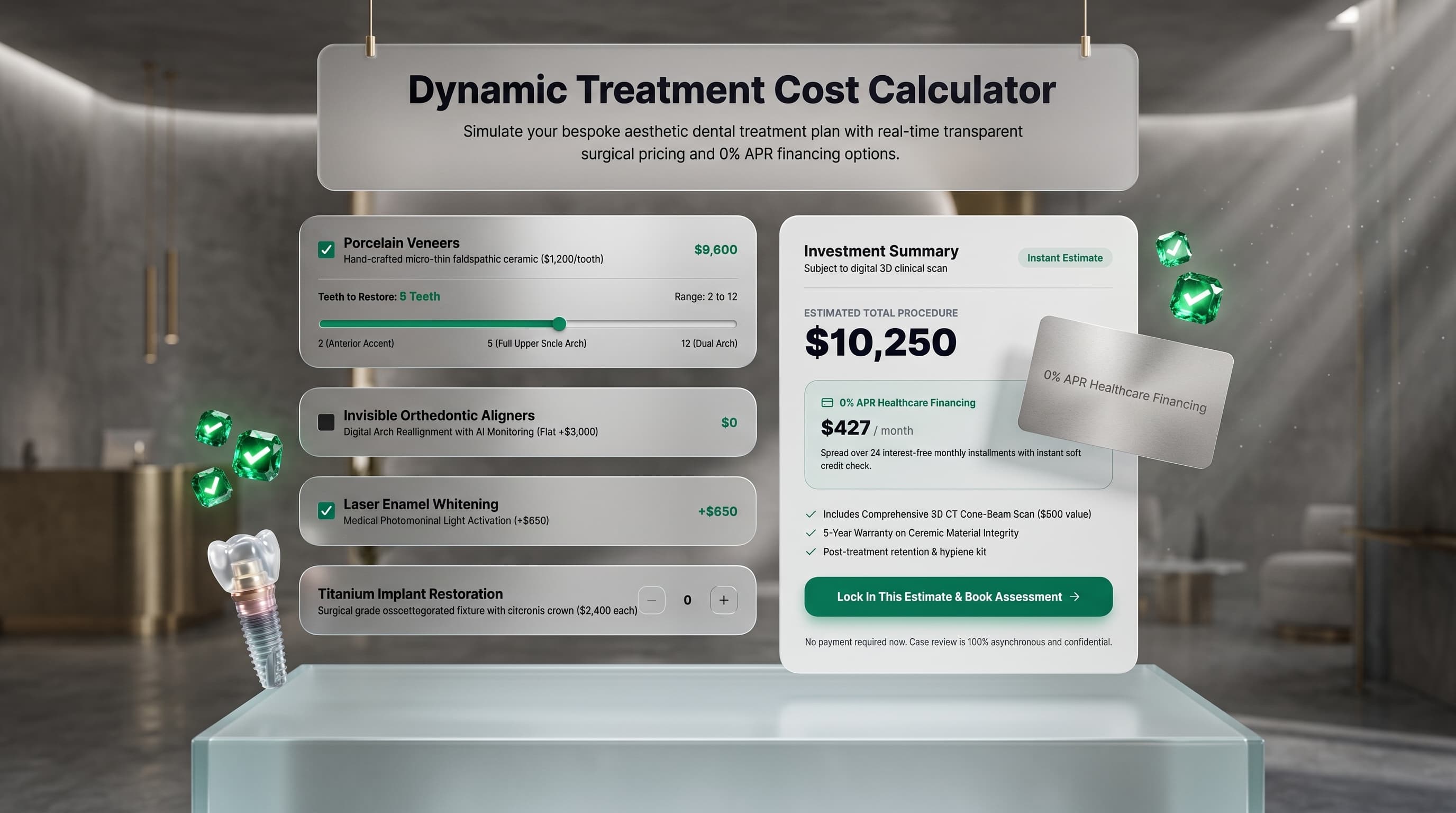
LUMINA resolves this with the Dynamic Treatment Cost Calculator—an interactive financial simulation engine built directly into the client application.
Features of the Algorithmic Calculator:
- Multi-Procedure Aggregation: Patients dynamically configure custom treatment combinations across porcelain veneers (adjustable unit range from 2 to 12 teeth), invisible orthodontic clear aligners, photothermal laser whitening, and titanium dental implants.
- Real-Time Recalculation: The state engine instantly updates the estimated total procedure investment with zero input delay using memoized calculation hooks.
- Transparent Financing Tiers: To reduce financial hesitation for high-ticket cases exceeding $10,000, the calculator dynamically computes 24-month and 36-month 0% APR healthcare installment plans in real time.
- Asynchronous Conversion Hook:Once patients customize their treatment configuration, clicking “Lock In This Estimate & Book Assessment” instantly transfers their selected parameters into the asynchronous intake drawer, saving their preferences and removing repetitive data entry.
// Algorithmic Treatment Pricing & Financing Quotation Engine
// Path: src/components/lumina/TreatmentCalculator.tsx
"use client";

import React, { useState, useMemo } from "react";

export function useTreatmentEstimation() {
  const [veneersCount, setVeneersCount] = useState<number>(8);
  const [includeVeneers, setIncludeVeneers] = useState<boolean>(true);
  const [includeAligners, setIncludeAligners] = useState<boolean>(false);
  const [includeWhitening, setIncludeWhitening] = useState<boolean>(true);
  const [implantsCount, setImplantsCount] = useState<number>(0);

  const VENEER_UNIT_PRICE = 1200;
  const ALIGNERS_FIXED_PRICE = 3800;
  const WHITENING_PRICE = 650;
  const IMPLANT_UNIT_PRICE = 2400;

  // Real-time zero-latency aggregation
  const estimation = useMemo(() => {
    const veneers = includeVeneers ? veneersCount * VENEER_UNIT_PRICE : 0;
    const aligners = includeAligners ? ALIGNERS_FIXED_PRICE : 0;
    const whitening = includeWhitening ? WHITENING_PRICE : 0;
    const implants = implantsCount * IMPLANT_UNIT_PRICE;

    const total = veneers + aligners + whitening + implants;
    const monthlyInstallment24 = Math.round(total / 24);
    const monthlyInstallment36 = Math.round(total / 36);

    return { total, monthlyInstallment24, monthlyInstallment36 };
  }, [veneersCount, includeVeneers, includeAligners, includeWhitening, implantsCount]);

  return { estimation, veneersCount, setVeneersCount, setIncludeVeneers };
}The Asynchronous Patient Intake (Zero-Call Protocol)
Traditional medical websites rely on generic “Contact Us” forms or direct telephone numbers. Telephone-based intake introduces substantial friction: staff must manually answer calls, patient inquiries often arrive after clinic operating hours, and patients are frequently hesitant to discuss medical concerns verbally without prior clinical review.
The Three Pillars of the Zero-Call Protocol
Performance Audit & Web Vitals Verification
Under simulated 4G mobile network throttling and low-tier CPU conditions on Google Chrome DevTools, LUMINA delivers exceptional performance metrics:
By stripping legacy CMS bloat and enforcing pure Next.js 16 modularity, LUMINA achieves sub-second load times that keep patient engagement high and bounce rates minimal.
Commercial Asset Acquisition & Production Deployment
LUMINA is packaged as a turnkey, production-grade Next.js 16 digital asset engineered for cosmetic dentists, medical clinics, aesthetic surgeons, and the digital agencies that serve them.
Included in the Commercial Source Package:
- Complete Next.js 16, TypeScript, and Tailwind CSS repository.
- Hardware-accelerated 60fps Before/After slider component.
- Dynamic Treatment Cost Calculator state engine with financing models.
- Asynchronous patient booking drawer with zero-call intake workflows.
- All 5 production routes:
/,/treatments,/results,/pricing,/contact. - Lifetime commercial rights for unlimited deployments on client or private projects.
Acquire the LUMINA Architecture
Deploy this sub-second aesthetic clinic web application for your healthcare brand or agency clients. Instant unminified source code package including all components, calculators, photography, and commercial license.