
Tesla Roadster Flying Car 2026: What's Real, What's AI, and Can It Really Fly?
An evidence-based guide to Tesla's October 2026 Roadster demonstration, SpaceX-assisted thrusters, the difference between real engineering and cinematic AI, and what the technology means for the future of automotive advertising.
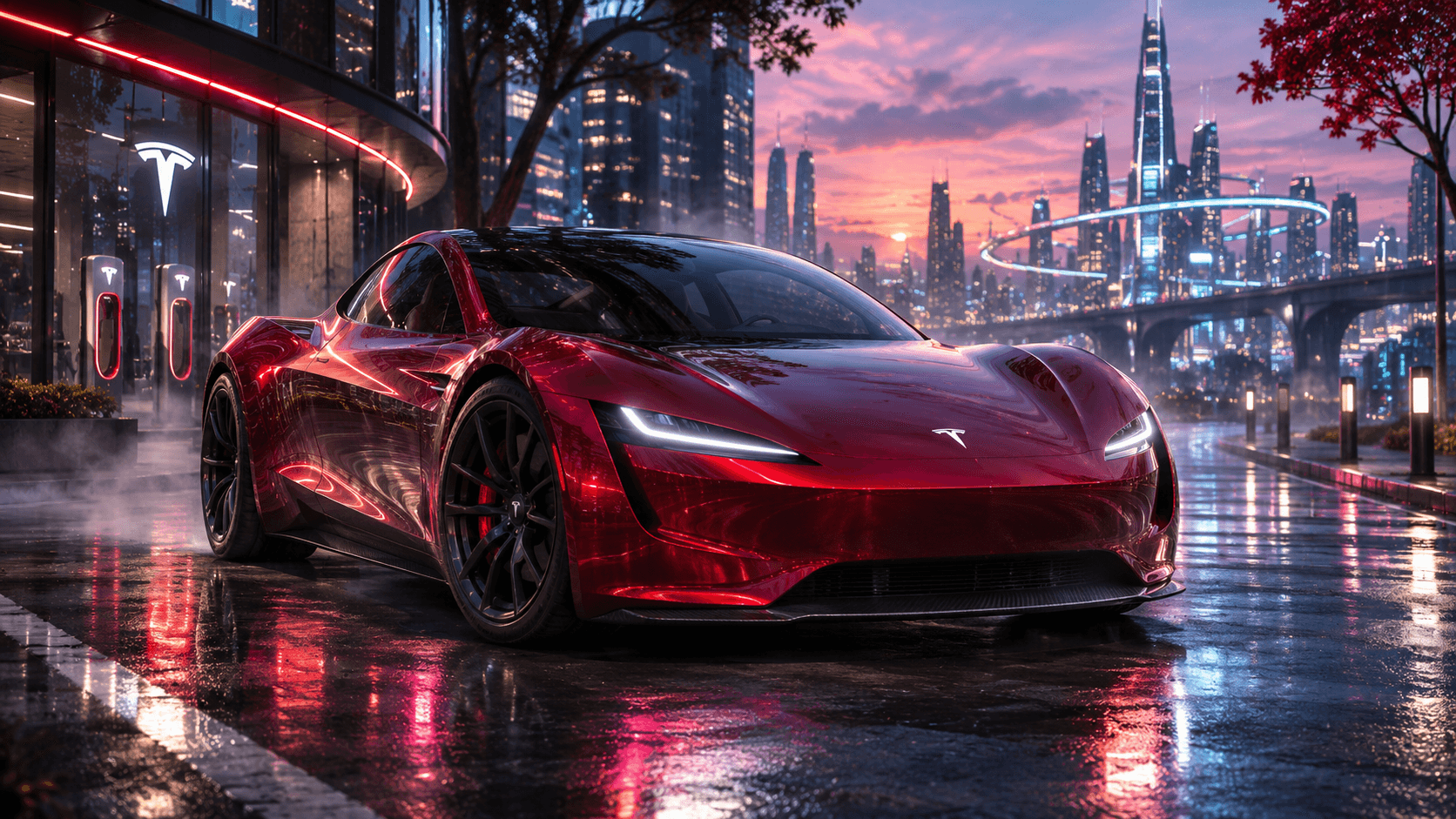
The idea of a flying Tesla has fascinated the internet for years.
For most of that time, the subject existed somewhere between ambitious automotive engineering, speculative technology, and science fiction.
Then, in October 2026, Tesla demonstrated a redesigned Roadster performing unusual midair maneuvers with assistance from a suction system and rocket-style thrusters.
Videos of the event quickly became a major topic in electric-vehicle and technology discussions.
But the demonstrations also raised an important question:
Can the Tesla Roadster actually fly, or are people confusing short, controlled aerial maneuvers with the kind of sustained flight shown in futuristic movies and AI-generated videos?
The answer requires separating several different things: what Tesla demonstrated, what the company currently claims, what has not been independently established, and what digital creators can produce using artificial intelligence and visual effects.
That distinction matters.
A real engineering demonstration can be extraordinary without proving that an everyday flying car is ready for public use. Equally, a breathtaking AI-generated commercial can be a powerful creative achievement without being footage of an actual vehicle.
In this guide, we examine the evidence, explain the technology at a practical level, explore the limitations of the flying-car concept, and show how AI SiteFlow approaches futuristic automotive advertising through original cinematic VFX.
What Happened at the Tesla Roadster Reveal in October 2026?
A long-awaited second-generation Roadster
Tesla first introduced its next-generation Roadster concept in 2017. The vehicle was positioned as an ambitious all-electric sports car, with dramatic performance goals and an unusual level of public attention.
However, the project faced repeated delays. For years, the central questions were not simply how fast the Roadster could accelerate, but whether the redesigned vehicle would enter production and how its final capabilities would compare with earlier promises.
The situation changed on October 15, 2026, when Tesla presented a redesigned Roadster during a demonstration at a SpaceX facility near Waco, Texas. Major automotive and technology publications documented the event, including Reuters, TechCrunch, and Car and Driver.
The demonstration brought attention to the Roadster's combination of electric propulsion, high-powered suction technology, and cold-gas thrusters. It was an unusual event even by high-performance automotive standards.
What the demonstration actually showed
Reports and footage from the event described the Roadster performing several extraordinary maneuvers. The prototype used a suction system to maintain contact with an inverted ramp. It then transitioned through a controlled aerial maneuver, rotating and returning to the ground with assistance from its thruster system.
Another demonstration showed the vehicle passing over other Tesla models while airborne. These were real demonstrations, not simply computer-generated sequences presented as live footage.
However, the fact that a prototype performed a particular maneuver does not automatically establish how a future customer vehicle will behave in ordinary operating conditions. A controlled demonstration and a production-ready transportation system have different engineering and regulatory requirements.
Why the event attracted so much attention
The Roadster demonstration brought together several ideas that people normally associate with different industries. Electric sports cars are already known for rapid acceleration. High-powered fans and aerodynamic systems are used to manipulate airflow and generate downforce. Rocket-style thrusters can produce forces that change an object's motion.
The unusual part was combining those concepts in a road-car-shaped prototype. Tesla and SpaceX presented this combination as a significant demonstration of engineering capability.
For the public, though, the most visually memorable detail was simpler: a car was briefly moving through the air in ways ordinary road vehicles cannot. That led to headlines describing the Roadster as a flying car. The phrase is exciting, but it needs a careful definition.
Can the Tesla Roadster Really Fly?
Short answer: It demonstrated aerial maneuvers, not ordinary city flight
Tesla's prototype performed genuine midair maneuvers using specialized systems. That is a meaningful technical demonstration. But it is different from proving that a consumer Roadster can continuously fly over a city, commute between destinations through the air, or operate as a practical replacement for a road vehicle.
The distinction is between limited controlled aerial capability and sustained, practical flight. A vehicle can leave the ground for a short period without becoming a conventional aircraft. Likewise, a vehicle that can briefly hover or alter its trajectory with thrusters may still face enormous challenges if engineers attempt to make it travel long distances through the air.
For a useful everyday flying car, designers would need to address more than a successful demonstration. They would need to establish safety, energy or propellant consumption, stability, control, landing procedures, emergency systems, maintenance, regulatory compliance, and appropriate operating environments. Those questions remain central to the Roadster discussion.
What Tesla's official website says
Tesla's current Roadster page describes multiple configurations, including versions with increasingly advanced performance systems. The company identifies a special Rocket configuration that incorporates cold-gas thrusters. Tesla describes this configuration as capable of upward acceleration and other aerial movement.
Tesla clearly states on its official product documentation that the Rocket configuration is not approved for public road use.
That limitation is extremely important. It means a dramatic capability described on a product page should not be confused with general authorization for normal road use or public aerial transportation. The technology may be remarkable, but legal availability and practical everyday operation are separate issues.
Is the flying Roadster available to ordinary buyers?
As of November 8, 2026, Tesla has announced a 2028 production target for the next-generation Roadster. A production target is not a guarantee that customers will receive vehicles on a particular date.
The company has not established that the full aerial-capability configuration will become a standard consumer product available for ordinary public-road or city-flight use. Tesla's official product information describes the Rocket version as invite-only and subject to restrictions.
The responsible conclusion is therefore straightforward: Tesla has demonstrated unusual aerial capabilities, but it has not established that a mass-market flying Roadster is ready for everyday driving and flight.
How Do Tesla Roadster's SpaceX-Inspired Thrusters Work?
The Roadster is especially interesting because the proposed technology is not simply a conventional aircraft engine fitted to a car. Instead, the design combines several different approaches to controlling vehicle movement.
The role of the suction system
Ordinary cars rely on tire contact with the road. Grip is affected by factors such as tire characteristics, surface conditions, weight transfer, and aerodynamic forces. Some racing vehicles use aerodynamic downforce to increase the effective load on their tires.
Tesla's Roadster concept goes further by using a multi-mode fan and ground-sealing system. According to Tesla, this system creates suction by removing air from beneath the vehicle. The pressure difference can generate a force that pulls the vehicle toward the surface.
In the October demonstration, the system helped the prototype maintain contact with an inverted ramp. That ability is visually dramatic because viewers are accustomed to gravity pulling cars away from overhead surfaces. It also illustrates why the word "flying" can become confusing. A vehicle held against an inverted ramp by suction is performing an extraordinary maneuver, but it is not necessarily flying through open air.
Understanding cold-gas thrusters
A cold-gas thruster uses stored pressurized gas to produce a force. When gas is released through a nozzle, the reaction force pushes the system in the opposite direction.
The basic principle comes from conservation of momentum. If a thruster pushes gas backward, the vehicle receives a forward reaction force. If thrust is directed in another direction, it may help change the vehicle's orientation or movement.
Unlike a conventional combustion rocket, a cold-gas system does not necessarily rely on burning fuel inside the thruster. However, storing, controlling, and releasing pressurized gas brings its own design challenges. The specific amount of usable thrust, its duration, tank arrangement, system weight, and safety characteristics determine what maneuvers are feasible.
Why thruster position matters
Where a thruster is placed affects what it can do. A nozzle near the rear of the vehicle may primarily support forward acceleration. Thrusters positioned around the vehicle can potentially create forces that change orientation or control movement in multiple directions.
This distinction helps explain Tesla's different Roadster configurations. An acceleration-focused setup and a multi-directional aerial-control system do not have identical requirements. A system intended to influence pitch, roll, yaw, or vertical movement requires careful coordination.
A visually impressive sequence also depends on vehicle stability. The force produced by the thrusters must interact with vehicle mass, center of gravity, aerodynamic effects, and existing motion.
Why short aerial stunts are different from long-distance flight
A short maneuver may need a burst of thrust. Sustained flight requires a way to continuously support and control the vehicle for a much longer period. That difference is fundamental.
Even if a vehicle can briefly rise above the ground, remaining airborne requires sufficient energy or propellant and reliable control over time. A car designed primarily for road use must also carry tires, suspension, structure, passenger systems, and other equipment. Those requirements create design trade-offs when the same vehicle is expected to perform aerial maneuvers.
The challenge is not merely producing enough force once. It is providing safe, repeatable, controllable flight across realistic conditions.
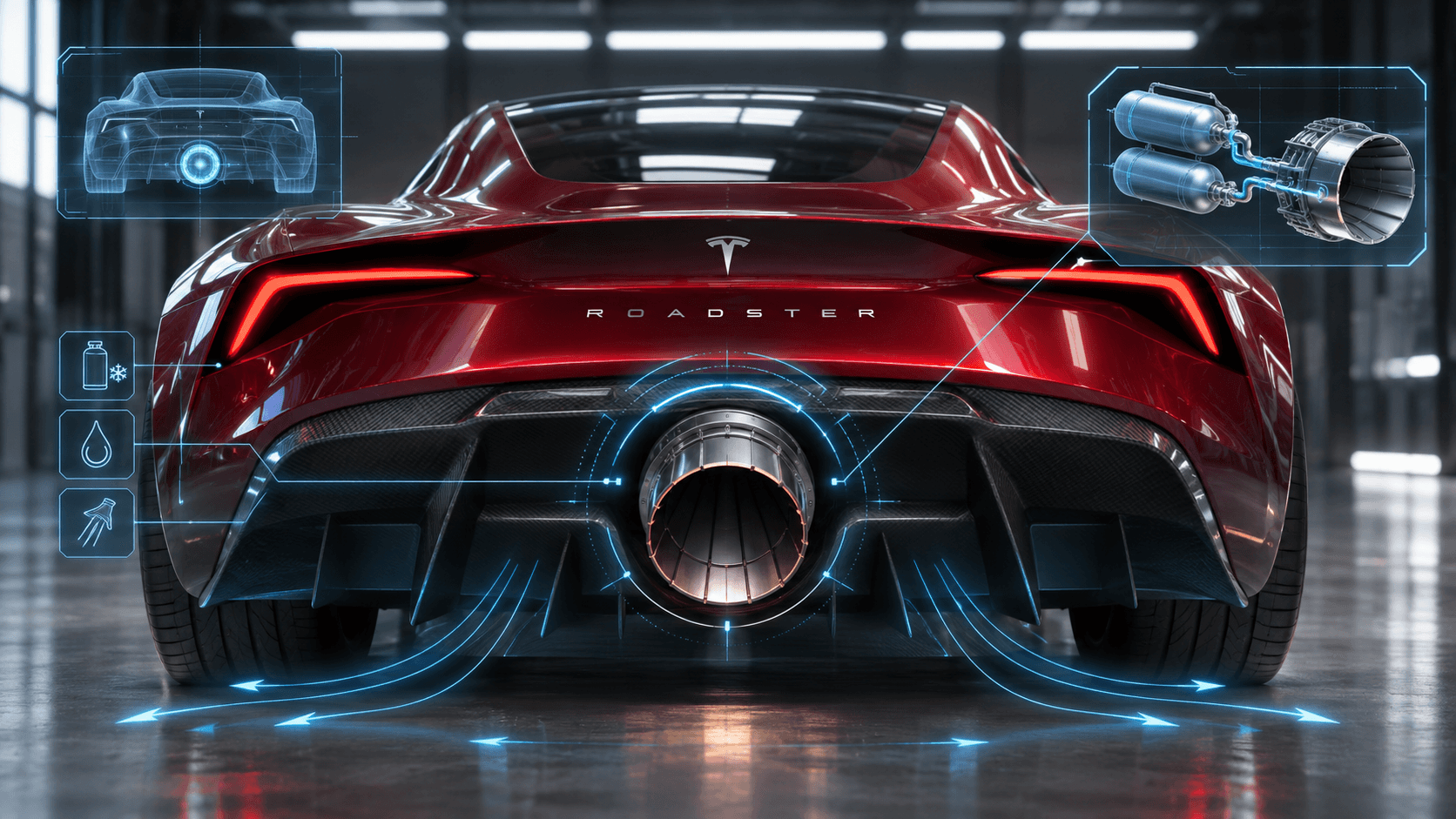
This illustration is a creative visualization of possible rear-mounted thruster design concepts. It is not a Tesla engineering drawing, a verified component layout, or a photograph of the production vehicle. Readers should consult Tesla's official documentation for the company's published descriptions.
Tesla Roadster 2026: Real Technology vs AI-Generated Flying-Car Videos
The October demonstration also highlights an increasingly important problem in online media. Real technology footage and AI-generated content can look remarkably similar.
Modern AI video systems can create realistic vehicles, lighting, explosions, thruster effects, environments, and cinematic camera movements. A visually convincing video is no longer enough to prove that an event actually happened.
What is real?
The October 15, 2026 Roadster event was a real demonstration. It involved an actual vehicle performing unusual movements at a controlled site. Independent media coverage and fact-checking examined the footage and its context. That gives viewers a stronger basis for understanding the event than an isolated viral clip with an unclear origin.
What is fictional?
A video showing a Roadster freely cruising above skyscrapers, overtaking airborne vehicles, or traveling across an entire city on sustained blue plasma jets should not automatically be interpreted as evidence of a real Tesla capability. Such imagery may be computer-generated, AI-assisted, edited, or otherwise fictional.
A futuristic automotive concept can intentionally exaggerate technology to explore an imaginative question: What would transportation look like if a high-performance electric sports car could escape road traffic entirely? That is a creative storytelling premise, not a technical claim.
Real demonstration vs AI concept
| Feature | October 2026 Roadster Demonstration | Cinematic AI Flying-Car Concept |
|---|---|---|
| Source | Actual controlled event footage | Generated or digitally composited imagery |
| Vehicle | Demonstration prototype | Digital representation |
| Environment | Test facility | Imagined city or futuristic setting |
| Aerial movement | Limited demonstrated maneuvers | Any motion the creator imagines |
| Engineering evidence | Actual observed demonstration | Not evidence of real engineering |
| Road legality | Depends on configuration and applicable rules | Not applicable to fictional footage |
| Purpose | Showcase vehicle capabilities | Storytelling, visualization, or creative advertising |
The table demonstrates why precise language matters. One type of footage documents something that happened. The other presents something that a creative team imagined. Both can be interesting, but they should not be described in the same way.
How to recognize misleading content
Start by checking the original source. Was the footage published by Tesla, an established news organization, or an independent creator? Look for a complete event recording rather than relying only on cropped reposts. Check whether credible reports describe the same event. Examine whether the video includes a disclosure such as "AI-generated concept" or "VFX demonstration."
Visual details may also provide clues. A vehicle's design may change between frames, reflections may behave strangely, and different objects may merge unnaturally. However, these clues are not definitive. AI-generated imagery can be convincing, and real footage can contain unusual camera effects. Source verification is more reliable than assuming that realistic visuals must be genuine.
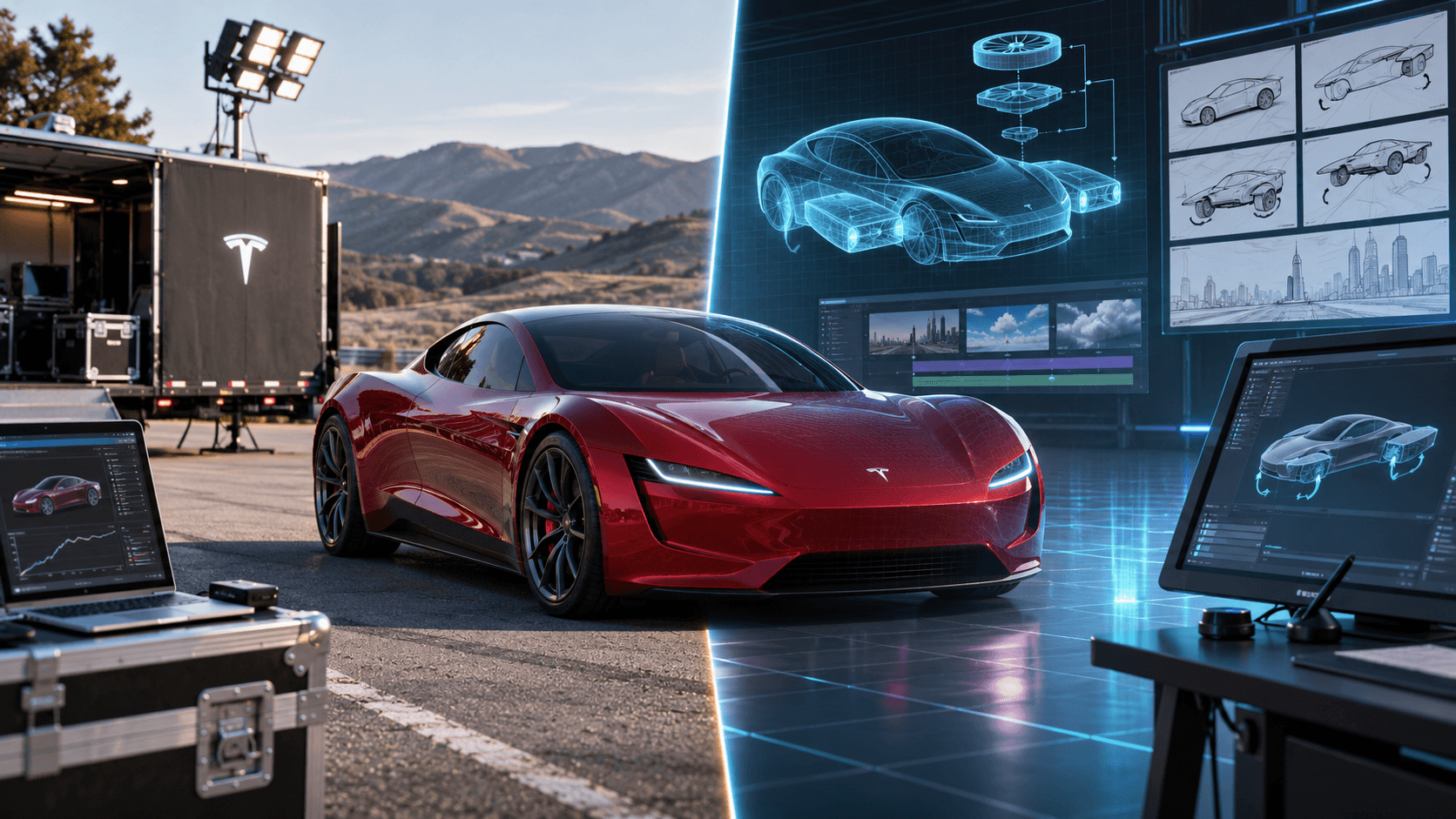
AI SiteFlow's 30-Second Flying Roadster VFX Concept
The attention surrounding Tesla's Roadster provides an interesting case study in contemporary advertising. A company can demonstrate genuine technology. At the same time, independent creators can use that technology as inspiration for imaginative storytelling.
At AI SiteFlow, we developed an independent 30-second futuristic flying-roadster concept to demonstrate our approach to AI-assisted commercial production. The project is not a Tesla commission. It is a speculative creative portfolio piece.
The objective was to create a high-energy automotive video combining futuristic design, dramatic cinematic effects, and action-comedy storytelling.
Watch the independent concept commercial
Video: Flying Roadster — Cinematic AI VFX Concept (30-second vertical short)
What the concept explores
The central idea is deliberately fictional. Imagine a sports car trapped in heavy city traffic. Instead of waiting, it activates a futuristic flight mode. The vehicle rises above the surrounding cars, accelerates into the skyline, and transforms an ordinary traffic problem into a spectacular sci-fi sequence.
A surprised police officer introduces a humorous contrast between normal city life and an impossible-looking vehicle. The concept is designed to feel like a short cinematic story rather than a series of unrelated technology effects.
Narrative structure
The opening establishes an everyday frustration: traffic. The second part introduces the extraordinary solution: flight. The middle sequence focuses on motion, scale, and visual spectacle. The ending gives the audience a memorable final moment.
This structure demonstrates an important principle in commercial production. Visual effects are strongest when they serve a recognizable story. A dramatic shot may attract attention, but a clear narrative helps audiences understand what they are watching.
Technical presentation
The completed AI SiteFlow portfolio video has the following file characteristics:
- •Duration: 30 seconds.
- •Orientation: vertical 9:16.
- •Resolution: 1440 × 2560 pixels.
- •Frame rate: 30 FPS.
- •Production type: AI-assisted cinematic VFX concept.
These specifications describe the finished portfolio export. They are not specifications for an actual Tesla vehicle.
Why this concept is useful in a portfolio
A speculative automotive commercial can demonstrate several production capabilities. These include motion-focused creative direction, visual continuity, environment design, camera planning, lighting, pacing, editing, and sound coordination. Potential clients can use such work to evaluate a studio's visual approach.
However, a speculative concept is not evidence that the featured brand hired or endorsed the creator. That distinction must remain clear.
This video is an independently created, unofficial AI-assisted VFX concept by AI SiteFlow. It is not affiliated with, sponsored by, commissioned by, or endorsed by Tesla, SpaceX, or their affiliates. The sustained city-flight scenes are fictional. Trademarks belong to their respective owners.
How AI Creators Build Cinematic Automotive VFX Commercials
A professional-looking AI automotive commercial is rarely just a matter of typing "make a flying car video." The creative process involves multiple decisions. It starts with defining what the viewer should feel and understand. Then the team develops the visual sequence, selects references, generates appropriate footage, and refines the result.
01Step 1: Define the concept
A strong concept can often be expressed in one sentence. For example: "A futuristic sports car transforms a traffic jam into a spectacular journey above the city." That sentence establishes the situation, turning point, and emotional direction. Without a clear concept, visually expensive scenes may fail to connect.
02Step 2: Design the environment
The city must support the story. Traffic provides the original problem. Tall buildings make the vehicle's flight appear more dramatic. Wet roads create appealing reflections. Sunset lighting adds warmth against blue thruster effects. The environment is not just a background. It helps establish scale, mood, and visual continuity.
03Step 3: Maintain vehicle consistency
One of the most difficult aspects of AI video production is maintaining a stable vehicle design. A car may appear different after a cut or camera movement. Headlights may change shape. Wheel positions may shift. Body panels can deform.
A studio can reduce these issues through reference images, careful shot planning, and visual inspection. For client work, accurate product references are particularly important. An advertisement must not quietly invent new features or change an actual product's appearance.
04Step 4: Plan the movement
For an action-oriented advertisement, movement needs a readable progression. A sudden liftoff might be followed by a controlled camera orbit. The next shot could reveal the vehicle against the skyline. A wide shot can establish scale. A close-up can emphasize a particular detail. Transitions should support the viewer's understanding rather than simply creating constant motion.
05Step 5: Design the visual effects
Visual effects should respond to the scene. For example, a powerful thruster could influence nearby dust, smoke, moisture, reflections, and atmospheric particles. Those secondary details can make the scene more visually coherent. However, effects should not be so exaggerated that the vehicle becomes difficult to identify. A visually impressive advertisement still needs a clear subject.
06Step 6: Use sound to support motion
Visual effects alone do not create the entire cinematic experience. Sound can help communicate scale, impact, timing, and energy. A low-frequency impact can emphasize a major transition. A brief mechanical sound can establish a fictional vehicle system. Ambient traffic noise can make the original city scene feel believable. Commercial productions should use original or properly licensed sounds.
07Step 7: Edit for clarity
Not every generated shot should appear in the finished video. A production team may remove sections that feel inconsistent, confusing, or visually weak. The strongest sequence is not always the one containing the most effects. It is the one that communicates the intended idea effectively.
08Step 8: Check the completed advertisement
Before publishing, review the video for:
Quality control is especially important when recognizable brands appear in an independent creative project.
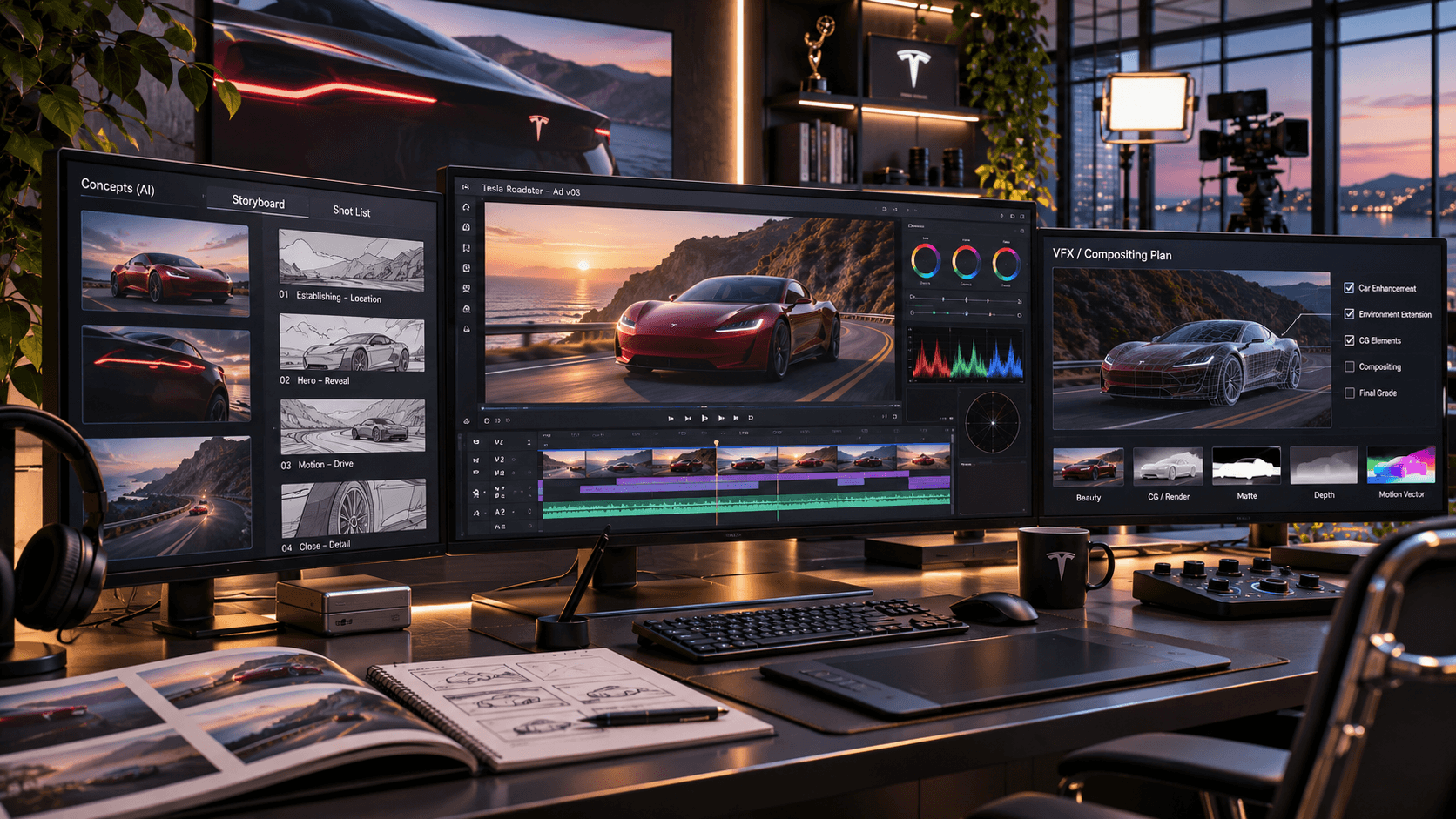
Why Cinematic AI Commercials Matter for Brands
The Roadster example reveals something broader than a discussion about flying cars. It shows how powerful a memorable visual idea can become.
People do not always remember individual product specifications. They often remember a surprising scene, a clear story, or a distinctive visual experience. For businesses, cinematic advertising can be useful when it connects those elements to an authentic product or service.
Product advertising
A premium consumer product can be presented through controlled lighting, macro photography, material textures, and carefully designed camera movement. For example, a watch advertisement might focus on its movement and craftsmanship. A coffee commercial might use realistic liquid motion and close-up product details. A furniture campaign might explore scale, texture, and interior design. The creative treatment should match the brand's positioning.
Automotive advertising
Automotive campaigns often benefit from movement, atmosphere, lighting, and environmental scale. A sports car concept may use sweeping camera moves and dramatic reflections. A luxury vehicle commercial may focus more on quiet detail, craftsmanship, or elegance. Not every automotive brand needs flying-car action. Different products require different creative approaches.
Restaurant and hospitality marketing
Restaurants can use cinematic product-focused video to present food preparation, atmosphere, and signature dishes. Hotels and hospitality brands may emphasize environment, mood, and guest experiences. However, businesses must distinguish conceptual or simulated imagery from genuine representations of real locations and products.
Why creative direction still matters
AI tools can produce impressive images and video sequences. They cannot automatically decide the most appropriate brand message. Professional creative direction connects the visuals to the business objective. It determines what the viewer should notice, understand, and remember.
For commercial clients, the real value is not simply generating video. It is creating an advertisement with a purposeful visual identity and a clear message.
The Future of Tesla Roadster Technology and AI Video Advertising
What could happen next for the Roadster?
Tesla has publicly identified 2028 as its production target for the redesigned Roadster. Future updates may clarify the available versions, production specifications, safety systems, pricing, and regional restrictions. For now, the demonstrated prototype and the announced production target should not be treated as proof of ordinary consumer availability.
The Rocket configuration raises additional questions because of its unusual propulsion system. Its regulatory status, practical operating limits, and final customer configuration remain important. Readers should rely on Tesla's current product documentation and credible reporting rather than assuming that every viral video represents a production-ready vehicle.
How AI changes futuristic product visualization
AI-assisted video generation makes it easier to visualize possibilities before they exist as physical products. A designer can imagine a vehicle in a city that has not been built. A creative studio can explore atmospheric lighting, unusual camera angles, and impossible transitions.
These tools can be valuable for conceptual presentations, entertainment, advertising development, and experimental visual storytelling. But there is also a responsibility to label synthetic imagery accurately. The more realistic AI-generated content becomes, the more important the distinction between a concept and documented reality becomes.
Why independent creative concepts should be clearly identified
An independent video featuring a well-known product can attract attention. However, recognizable branding may also lead viewers to assume that the company officially commissioned the advertisement. Creators should avoid making that claim without a genuine business relationship.
They should also respect trademarks, copyrights, likeness rights, and applicable platform policies. A disclaimer helps communicate the nature of a project, but it does not automatically provide permission to use third-party intellectual property. Responsible production protects both the audience and the creator.
Where AI SiteFlow fits
AI SiteFlow is a creative studio founded by Waqas Ahmad in Pakistan. Our work focuses on AI-assisted cinematic commercials, visual effects concepts, product advertising, and digital creative production.
The Flying Roadster video is one example of our independent creative direction. It demonstrates how an imaginative concept can be developed into a short cinematic piece.
For businesses, we focus on adapting that visual approach to the brand's actual products, audience, and campaign needs. A commissioned commercial should always begin with a clear creative brief and appropriate brand assets.
Direct studio inquiries: build@aisiteflow.agency
Frequently Asked Questions About the Tesla Roadster Flying Car
Independent answers to the most common questions regarding the 2026 Roadster demonstration, SpaceX thruster rumors, and automotive AI VFX.
Tesla demonstrated a redesigned Roadster performing controlled aerial maneuvers on October 15, 2026. This included movements assisted by suction technology and thrusters. The demonstration does not by itself establish practical, sustained city-flight capability.
Final Thoughts: The Roadster Is Real, but the Future Is Still Being Built
The Tesla Roadster's October 2026 demonstration was a striking example of experimental automotive engineering. It showed a physical vehicle performing maneuvers that challenge ordinary expectations of how a car should move.
Yet there is an important difference between a successful controlled demonstration and an everyday flying transportation product. That distinction should remain central to any discussion of the Roadster's future.
At the same time, the attention surrounding the vehicle shows why futuristic automotive concepts are such compelling subjects for visual storytelling. AI and VFX allow creators to imagine possibilities that are not yet practical or commercially available.
The opportunity is not to confuse fiction with reality. It is to communicate both responsibly.
At AI SiteFlow, we approach that challenge through cinematic creative direction, original concepts, and visually ambitious commercial production.
Interested in creating an original cinematic advertisement for your business? Explore our work at https://aisiteflow.agency/commercials or contact build@aisiteflow.agency.
Sources and Further Reading
The following resources support the technology, event, and regulatory claims discussed in this article.
- Tesla — Official Roadster Product Page
Primary reference for Tesla's published configurations, suction systems, Rocket trim description, and public-road restriction.
- Reuters — Tesla's New Roadster Turns in Air With SpaceX Thrusters, Won't Land Until 2028
October 15–16, 2026. Independent reporting on the demonstration and announced production target.
- TechCrunch — Tesla Reveals SpaceX-Powered Roadster That Flies and Falls With Style
October 15, 2026. Event coverage and explanation of the Roadster demonstration.
- Car and Driver — New Tesla Roadster Takes Flight With SpaceX Thrusters
October 16, 2026. Automotive reporting on the prototype and performance claims.
- CBS News — Who Would Regulate a Flying Car Like Tesla's Roadster?
October 16, 2026. Discussion of regulatory questions surrounding the unusual vehicle.
- Google Search Central — Creating Helpful, Reliable, People-First Content
Guidance on accuracy, original experience, authorship, and content quality.
Editorial and Image Disclosure
This article was prepared with AI-assisted research and drafting for editorial review by Waqas Ahmad at AI SiteFlow.
Descriptions of Tesla's engineering, product plans, and regulatory status are based on publicly available information as of November 8, 2026, and may change.
The article's four original illustrations are AI-generated editorial concepts. They are not official Tesla photographs, verified technical schematics, or documentary images of the October 2026 demonstration.
The AI SiteFlow Flying Roadster video is an independent fictional VFX concept, not a commissioned or endorsed Tesla commercial.
AI SiteFlow is not affiliated with Tesla or SpaceX. All third-party trademarks remain the property of their respective owners.
Ready to Bring Your Brand to Life with Cinematic AI?
From photorealistic commercial reels to full-scale monthly video pipelines. Explore our commercial portfolio or book your custom commercial sprint today.