
Frontier AI Model Leaderboard 2026: Comprehensive Benchmark Analysis, Speed, Cost & Architectural Comparison
The frontier artificial intelligence ecosystem in late 2026 has reached a decisive inflection point. The era of evaluating large language models purely on static multiple-choice academic benchmarks (such as legacy MMLU or GSM8K) is completely over. Today, enterprise leaders, autonomous software engineers, and creative production studios measure models on rigorous, contamination-resistant real-world execution: multi-turn autonomous tool use, dynamic browser automation, complex mathematical reasoning, inference latency, and real dollar cost per task.
Drawing from the latest reported daily evaluations across the industry's three gold-standard independent testing authorities—LiveBench 2.0, Artificial Analysis, and LMSYS Chatbot Arena (Arena.ai)—this comprehensive analysis breaks down the real architectural strengths, speed trade-offs, and cost equations of the top 17 frontier models operating today.
Whether you are architecting autonomous customer-facing sales agents, building high-throughput developer pipelines, or evaluating visual generative models for cinematic brand commercials, understanding where each frontier model excels—and where its unit economics break down—is the single most important technical advantage in 2026.
1. The 2026 Frontier Landscape: Beyond Raw Parameter Counts
For years, model comparisons were dominated by simple parameter estimates and vendor-reported benchmarks often tainted by evaluation set contamination. In 2026, the industry standard has consolidated around three independent evaluation frameworks that isolate real-world model competence:
- LiveBench 2.0: An objective, monthly updated benchmark that prevents data contamination by releasing fresh problems across complex reasoning, coding, data analysis, visual design, and agentic browser use. Questions are verified against automated test suites and human inspection.
- Artificial Analysis Intelligence Index & Efficiency Metrics: Standardized, independent benchmarking that calculates an aggregated Intelligence Index while measuring precise wall-clock time per task, first-token latency (TTFT), and the actual dollar cost required to resolve complex real-world prompts.
- LMSYS Chatbot Arena (Arena.ai): The premier blind, crowdsourced human preference arena where users rate side-by-side completions to establish statistically robust Bradley-Terry Elo ratings.
💡 Test These Numbers Live
You can explore the full, interactive benchmark matrix, filter by provider, and compare any two or three models head-to-head directly on our verified hub: Open the Interactive AI SiteFlow Leaderboard (/ai-leaderboard) →
2. Category Champions: Why No Single Model Wins Every Dimension
The single most important finding of the late 2026 evaluations is that no individual model holds the crown across all dimensions. Instead, frontier AI has fractured into specialized domain leaders:
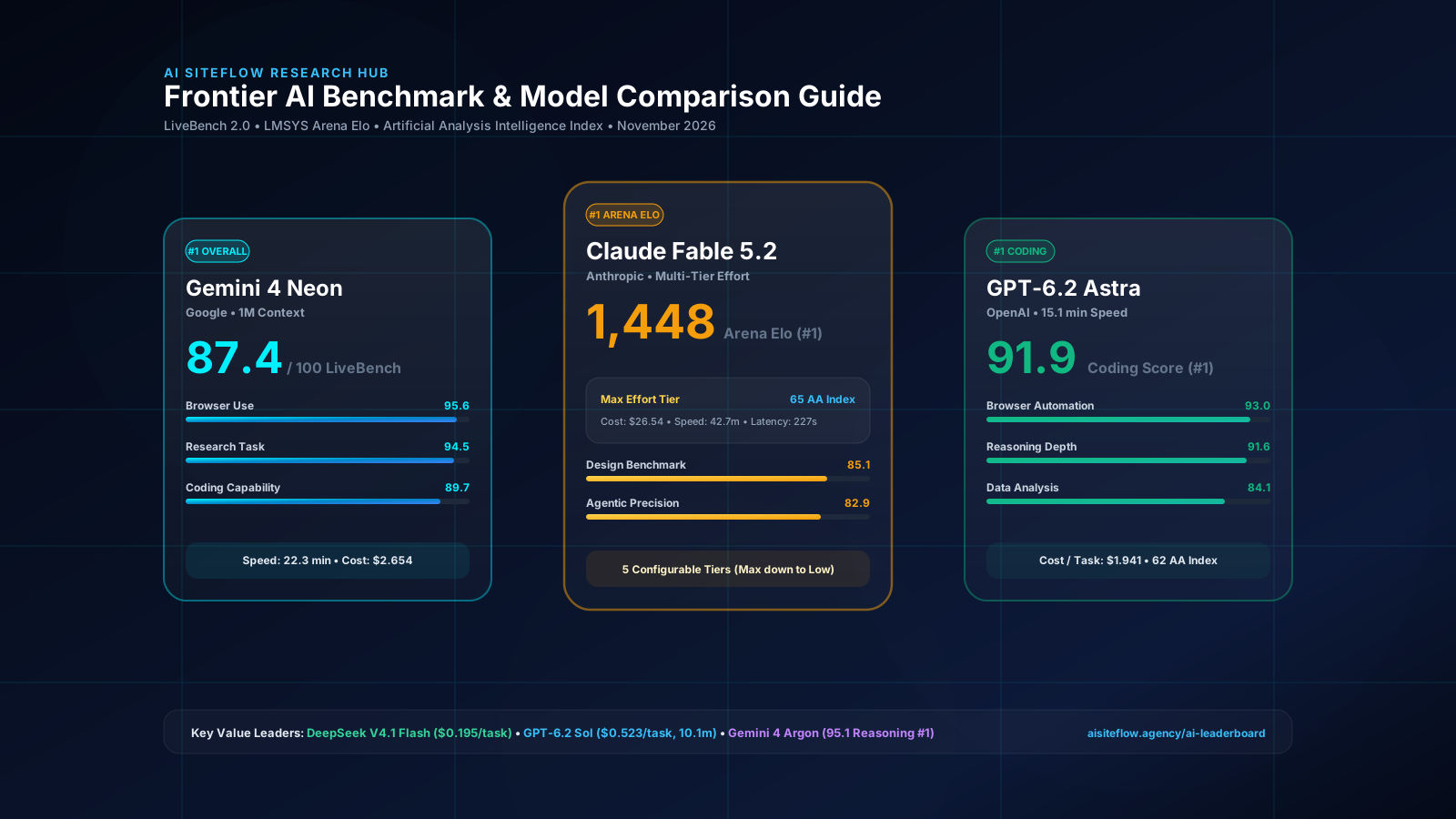
Driven by 95.6 Browser Use and 94.5 Research scores with 22.3m completion time.
Holds #1 human preference Elo and peak 65 Artificial Analysis Intelligence Index.
Highest coding benchmark, finishing tasks in 15.1m at only $1.941/task.
Highest pure logic score across all evaluated models with an agile 40s TTFT.
3. Gemini 4 Neon: The LiveBench 2.0 and Autonomous Agent Leader
Google’s Gemini 4 Neon represents the pinnacle of multi-modal, agentic web execution in 2026. With an overall LiveBench 2.0 score of 87.4, Gemini 4 Neon establishes clear separation from the competitive field primarily through two capabilities:
- Unmatched Browser Automation (95.6): When autonomous agents must interact with live web applications—clicking navigation elements, filling multi-step forms, parsing complex shadow DOM structures, and reacting to layout reflows—Gemini 4 Neon operates with near-flawless accuracy.
- Deep Research Synthesis (94.5): The model excels at fanning out over dozens of external documentation pages, aggregating contradictory data sources, and producing calibrated, hallucination-free executive reports.
- Balanced Unit Cost ($2.654 per task): Unlike traditional brute-force chain-of-thought models that bill tens of dollars for deep research, Gemini 4 Neon resolves standard benchmark tasks in 22.3 minutes at an accessible $2.654 per task.
4. Claude Fable 5.2: Maximum Intelligence, Arena Elo (#1), and Configurable Effort Tiers
Anthropic’s Claude Fable 5.2 is currently the undisputed king of human conversational preference and raw intelligence. On LMSYS Chatbot Arena, Fable 5.2 commands the #1 position worldwide with an Elo rating of 1,448, beating out its sibling Claude Opus 5.5 (1,336) and OpenAI’s GPT-6.2 Astra (1,291).
What makes Claude Fable 5.2 groundbreaking for enterprise architecture is its dynamic effort tier system evaluated by Artificial Analysis. Instead of treating intelligence as a static fixed price, engineering teams can dial in the reasoning compute allocated to each request:
| Effort Tier | AA Intelligence Index | Cost per Task | Completion Speed | First Token Latency (TTFT) |
|---|---|---|---|---|
| Max Effort (Frontier #1) | 65 | $26.54 | 42.7 min | 227.90s |
| Xhigh Effort | 62 | $14.83 | 24.6 min | 64.37s |
| High Effort | 62 | $9.08 | 14.9 min | 22.97s |
| Medium Effort | 56 | $3.80 | 6.6 min | 11.24s |
| Low Effort | 54 | $3.10 | 5.6 min | 8.28s |
This flexibility allows development teams to use Low or Medium tiers ($3.10 to $3.80) for rapid user interaction while routing high-stakes legal contracts or system architecture reviews to Max ($26.54).
5. GPT-6.2 Astra vs GPT-6 Astra: OpenAI's Coding Dominance and Speed Optimization
In software engineering benchmarks, OpenAI’s GPT-6.2 Astra is the definitive champion. It leads all evaluated models with an astonishing 91.9 Coding score on LiveBench 2.0, outperforming Claude Fable 5.2 (79.2) and Gemini 4 Neon (89.7).
Equally impressive is OpenAI’s focus on inference latency. While foundational frontier models frequently take 30 to 45 minutes to execute multi-tool reasoning sequences, GPT-6.2 Astra finishes its full evaluation suite in 15.1 minutes—more than twice as fast as Claude Fable 5.2 (42.7m) and significantly faster than Gemini 4 Carbon (34.7m). At $1.941 per task, GPT-6.2 Astra represents the sweet spot for modern software engineering agents and autonomous codebases.
6. Pure Reasoning Benchmark: Why Gemini 4 Argon Out-Thinks the Field (95.1)
When tasks require pure symbolic logic, novel mathematical proofs, and unassisted step-by-step deduplication without relying on web search crutches, Gemini 4 Argon delivers an unrivaled score of 95.1 in Reasoning.
For comparison, foundational models like GPT-6 Astra reach 92.7, Claude Opus 5.5 reaches 92.2, and Claude Sonnet 5.5 reaches 91.6. Furthermore, Gemini 4 Argon boasts an exceptionally responsive 40-second Time to First Token (TTFT), making it the preferred backend for real-time mathematical validation and complex scientific reasoning workflows.
7. Value Engineering & Production Unit Economics: DeepSeek V4.1 Flash ($0.195) vs GPT-6.2 Sol ($0.523)
While frontier model battles focus on peak benchmark scores, real-world commercial viability is determined by unit economics. In high-volume production systems processing millions of interactions daily, running a $10 to $26 model per request is financially impossible.
Two models stand out as masters of price-to-performance efficiency in late 2026:
DeepSeek V4.1 Flash 1017
Delivers an 80.4 Coding score and 89.1 Reasoning score at less than one-tenth the cost of competing frontier models. For self-hosted open-weights deployments, it provides unmatched throughput.
OpenAI GPT-6.2 Sol
The fastest model in the entire benchmark suite at just 10.1 minutes completion time while maintaining an 80.3 LiveBench overall and 90.6 Reasoning.
8. How AI SiteFlow Routes Frontier Models for Commercial Ads & Web Systems
At AI SiteFlow (aisiteflow.agency), we do not treat AI models as academic abstractions. We deploy frontier AI intelligence every single day to engineer cinematic AI commercial video ads, high-converting digital storefronts, and autonomous brand sales agents for modern businesses worldwide.
Our proprietary production pipeline uses multi-model orchestration to deliver Hollywood-grade commercial production in under 24 hours:
- Creative Concepting & Screenplay Architecture: We route initial brand creative direction, character story arcs, and emotional hooks through high-context frontier reasoning models to guarantee viral narrative hooks.
- Proprietary AI Video & VFX Pipeline: We blend generative video engines (Google Veo, Seedance, Higgsfield Cinematic, and Kling) with custom post-production VFX, color grading, photoreal sound design, and typography.
-
Transparent, Risk-Free Pricing:
- Basic Ads (1080p 30fps): 15s ($50), 30s ($90), 45s ($130), 60s ($150). Includes a 30-Second Free Test Ad ($0) for eligible verified brands.
- Premium Ads (2K Cinema Target, Advanced VFX, 4 Revisions): 15s ($299), 30s ($449), 45s ($599), 60s ($699), plus a 25-Second Paid Test Ad for just $75.
- 80% Conditional Refund Policy: 50% deposit to start, remaining 50% on final approval, with an 80% refund guarantee before final watermark-free file release.
Ready to Turn Frontier AI Capabilities Into High-Converting Video Ads?
Explore our commercial video archive, calculate exact project pricing with our real-time calculator, or book an introductory test commercial sprint today.
9. Interactive Benchmark Tool: Compare Models Head-to-Head
Choosing the right model for your architecture requires hands-on comparison. AI SiteFlow maintains a dedicated, daily-updated benchmark comparison portal where you can evaluate any two or three frontier models across 11 key metrics simultaneously.
Launch Side-by-Side Model Comparison Tool →
10. Frequently Asked Questions (FAQ)
Which model is the best overall in late 2026?
On objective automated benchmarks, Google’s Gemini 4 Neon holds the #1 spot on LiveBench 2.0 with an overall score of 87.4, driven by superior browser automation (95.6) and research (94.5). For human conversational nuance and blind preference, Anthropic’s Claude Fable 5.2 ranks #1 on LMSYS Chatbot Arena with an Elo of 1,448.
What is the fastest frontier model for software coding?
OpenAI’s GPT-6.2 Astra achieves the highest coding score (91.9) with an industry-leading completion time of 15.1 minutes. For budget-constrained development, GPT-6.2 Sol executes tasks in 10.1 minutes at just $0.523 per task.
How does DeepSeek V4.1 Flash compare to proprietary frontier models?
DeepSeek V4.1 Flash 1017 delivers 80.4 Coding and 89.1 Reasoning at $0.195 per task. While it trails top frontier models in browser agent automation (67.2 vs 95.6 for Gemini 4 Neon), its unit economics make it the premier choice for high-volume backend data processing and open-weights hosting.
Get a Free Basic Custom AI Ad Sample
Own a product or business? Let AI SiteFlow create a basic AI-powered advertising sample tailored to your brand.
Related Intelligence & Guides
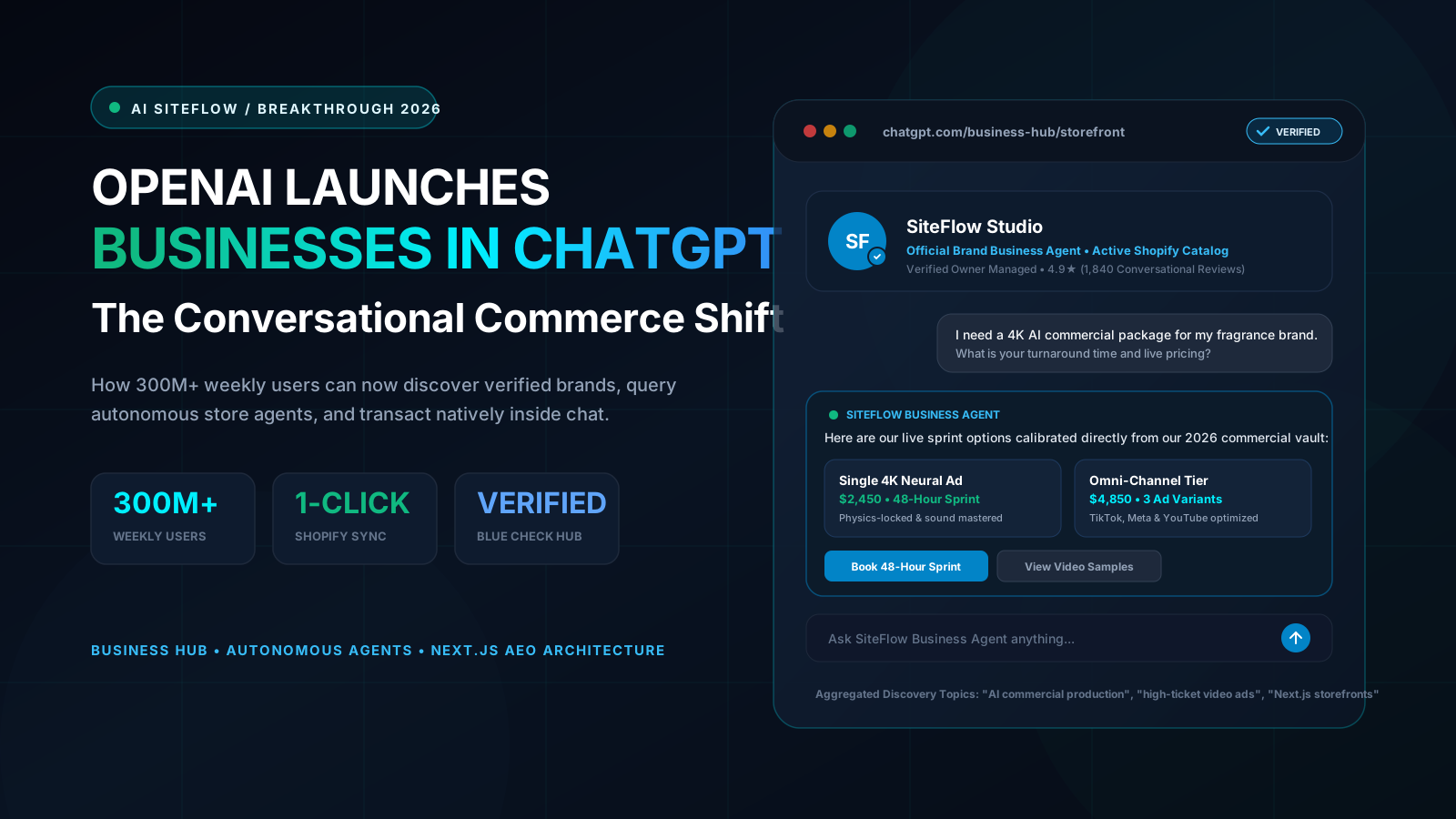
OpenAI Launches 'Businesses in ChatGPT': What Brands Need to Know About the 2026 Conversational Commerce Revolution
OpenAI has officially launched Businesses in ChatGPT, rolling out verified profiles, live Shopify catalog synchronization, and autonomous brand agents. Discover the complete 2026 architectural playbook for conversational search and ecommerce.

AI Product Video Ads for Ecommerce in 2026: Turn One Product Photo Into Three Commercial Styles
Discover how ecommerce brands can turn one product photo into three cinematic AI video ad concepts, with production tips, examples, and creative strategies.
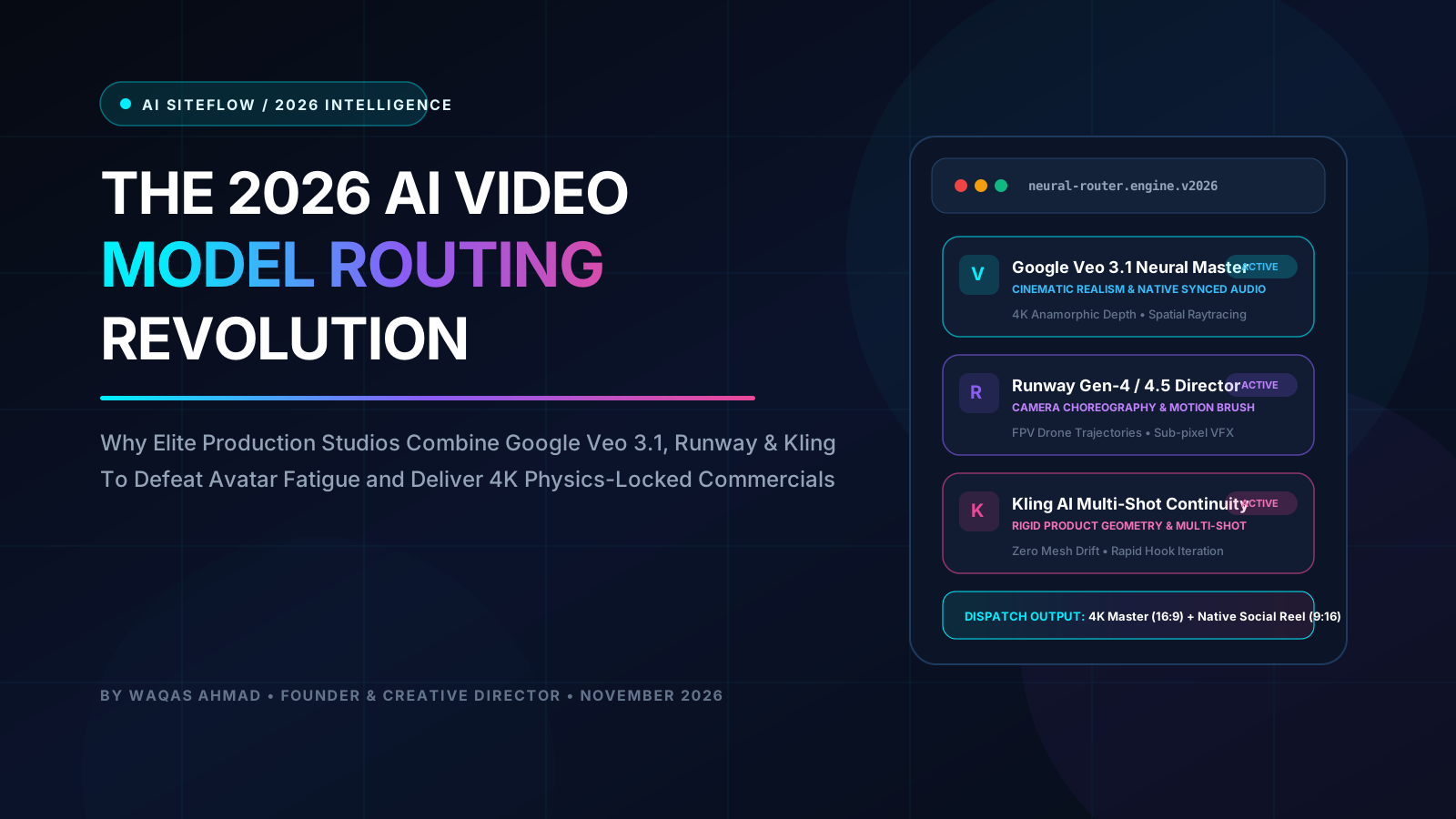
Today's AI Video Commercial Breakthrough (2026): Why Model Routing Replaces Cheap UGC Avatars with 4K Neural Cinema
Discover the late 2026 AI video breakthrough: why OpenAI's Sora exit reshaped ad production, how multi-model routing (Google Veo 3.1, Runway Gen-4 & Kling) defeats avatar fatigue, and how AI SiteFlow engineers 4K neural commercials.
Ready to Elevate Your Brand With AI Commercials?
From single high-impact commercial launches to full-scale monthly video pipelines. Explore our benchmark portfolio or commission your custom sprint today.