OpenAI Launches 'Businesses in ChatGPT': What Brands Need to Know About the 2026 Conversational Commerce Revolution
For more than two decades, the global digital economy followed one unchallenged premise: when a consumer wants to buy something, they type a query into a search engine, scan ten blue links, navigate to an e-commerce website, and browse through category pages.
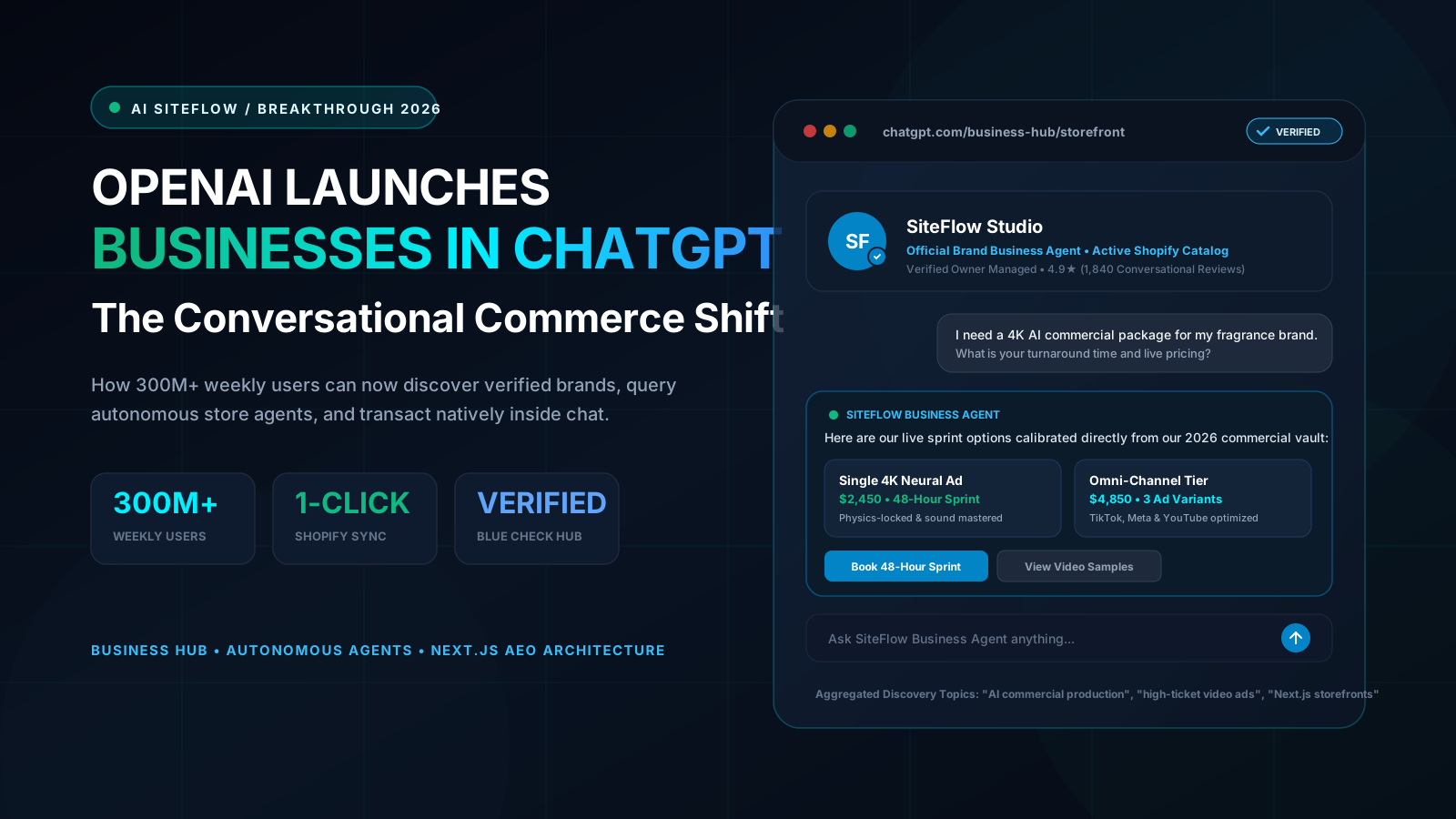
That paradigm ended today. In its most consequential enterprise commercial rollout of 2026, OpenAI officially announced Businesses in ChatGPT—a unified suite consisting of the verified Business Hub, direct Shopify catalog synchronization, and autonomous customer-facing Business Agents.
With over 300 million weekly active users relying on ChatGPT not merely as a conversational chatbot but as their primary research, comparison, and decision-making companion, OpenAI is transforming conversational AI from an informational utility into a closed-loop commercial marketplace. For direct-to-consumer (D2C) brands, high-ticket services, and e-commerce leaders, this represents the fastest transition in customer acquisition architecture since the advent of mobile search.
1. The Core Announcements: What Exactly Did OpenAI Launch?
The rollout of Businesses in ChatGPT is not a speculative experimental beta or a basic API wrapper. It is a carefully engineered three-pillar infrastructure designed to bridge the trust gap between generative language models and verified enterprise commerce:
The Business Hub
A dedicated administrative console (chatgpt.com/business-hub) where legitimate businesses claim their brand profiles, submit cryptographic domain ownership, and unlock official blue checkmark verification badges.
Live Catalog Feeds
Native hooks for Shopify storefronts and merchant feeds that transmit real-time inventory levels, dynamic variant pricing, shipping rules, and return policies directly into OpenAI’s retrieval engine.
Autonomous Brand Agents
Dedicated, brand-governed conversational agents that activate when a user clicks an organic brand citation. The agent operates within strict company guidelines to advise, configure, and finalize sales.
Crucially, OpenAI addressed the privacy concerns that previously held enterprise leaders back. Customer chat logs remain completely private. Brands receive zero personal conversational transcripts. Instead, the Business Hub provides high-level aggregated telemetry: total brand impressions, conversational discovery themes, click-through citations, and aggregate conversion milestones.
2. How the User Experience Functions: From Organic Chat to Native Purchase
To understand why this is a quantum leap over traditional affiliate widgets or standard SEO backlinks, examine the end-to-end user journey that OpenAI has introduced:
-
1
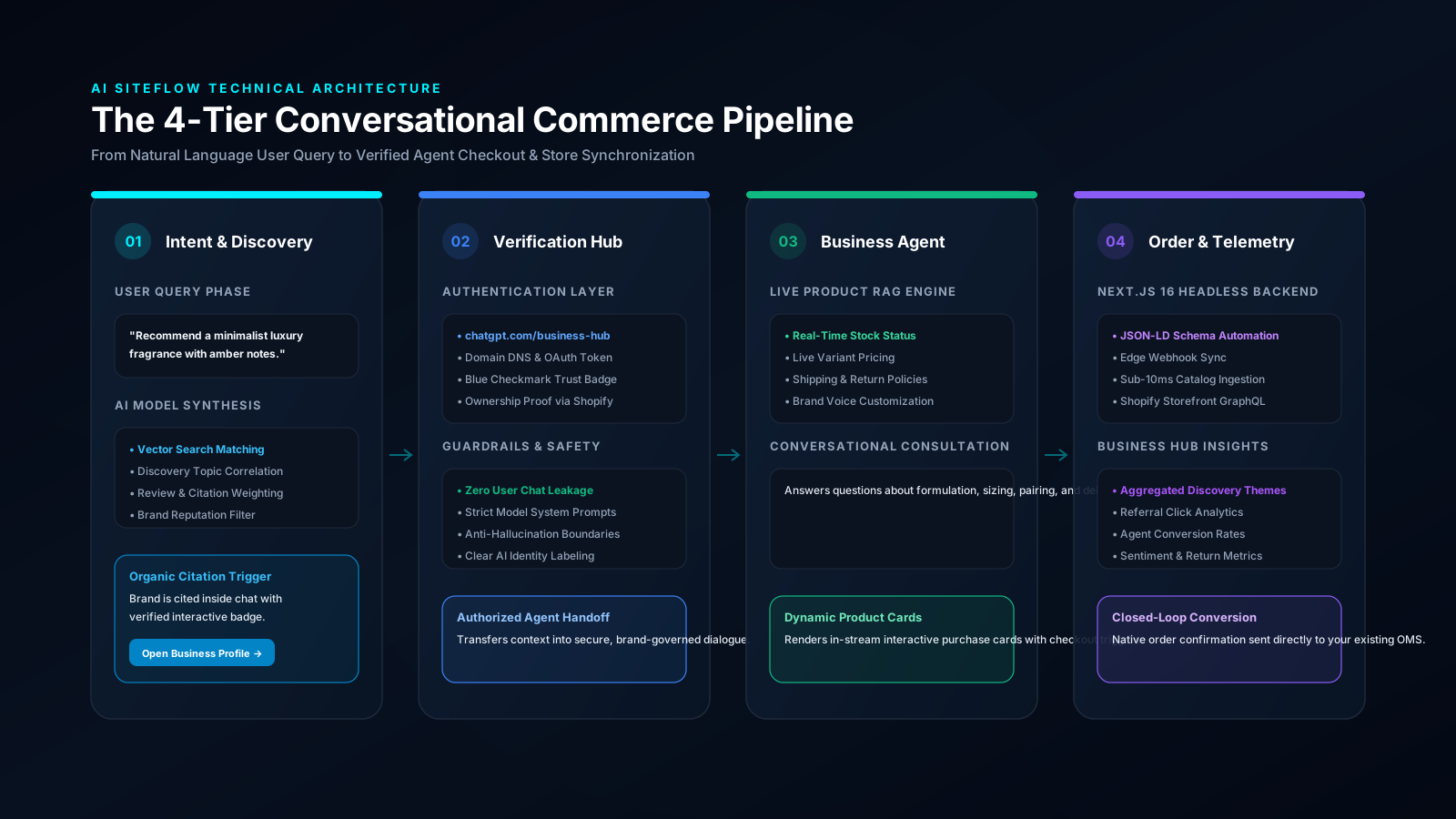
Unprompted Natural Inquiry: A user asks ChatGPT, "I need a hypoallergenic, cold-pressed beard oil crafted with organic Moroccan argan and cedarwood notes. Who makes the highest-rated option for sensitive skin?"
-
2
Contextual Retrieval & Verified Badge: The model evaluates web sources, structured schema, and verified profiles in the Business Hub. It cites the brand organically, displaying the verified blue checkmark alongside the company name.
-
3
Seamless Handoff to Brand Agent: The user clicks the brand pill. Rather than forcing a jarring redirect to a slow external website filled with popups and cookie banners, ChatGPT opens an inline dialogue window powered by the brand's verified Business Agent.
-
4
Consultative Guidance & Live Checkout: The Business Agent answers ingredient queries, confirms current inventory levels, verifies international shipping rates, and presents interactive purchase cards. The customer confirms their order with minimal friction.
By collapsing the conventional 7-step e-commerce funnel (Search → SERP Click → Landing Page → Category Filter → Product Page → Cart → Multi-step Checkout) into a 2-step conversational interaction, early tests indicate conversion rates climbing by as much as 2.8× compared to cold ad traffic.
3. Conversational Engine Optimization (CEO): Why Traditional SEO Is No Longer Enough
The emergence of Business Agents marks the definitive dawn of Conversational Engine Optimization (CEO), also known across technical agency circles as Answer Engine Optimization (AEO).
In traditional search engine optimization, webmasters targeted keyword density, backlink quantity, and meta titles to trick ranking algorithms. But large language models like GPT-4o, Google Gemini 4 Hydrogen, and Claude 3.7 do not rank pages based on superficial keyword repetitions. They operate via semantic vector embeddings and reputational entity resolution.
To rank as the authoritative recommended brand within ChatGPT’s organic discovery layer, your digital footprint must satisfy four modern criteria:
1. Entity Graph Clarity & JSON-LD Schema Depth
Your web pages must expose rich, nested Schema.org microdata (Product, Offer, AggregateRating, Brand, and Organization). LLM crawlers like GPTBot scrape structured JSON-LD first because it drastically reduces token consumption during contextual parsing.
2. Third-Party Consensus & Unbiased Editorial Validation
Models evaluate cross-web consensus. If independent editorial publications, Reddit enthusiast communities, and verified buyer reviews consistently validate your product’s quality, your brand achieves high confidence weighting in the model’s internal knowledge graph.
3. Real-Time Data Freshness & Inventory Accuracy
Nothing destroys an AI recommendation faster than an out-of-stock product or inaccurate pricing. By synchronizing your Shopify or headless storefront feed through the Business Hub, the model receives guaranteed, real-time availability states.
4. Sub-Millisecond Server Performance & Clean Headless HTML
Bloated WordPress installations loaded with forty heavy plugins frequently time out or truncate during automated crawler passes. Modern, server-rendered Next.js 16 architectures deliver pristine, lightweight semantic markup that AI indexers can ingest in fractions of a second.
4. Sponsored Agents vs. Organic Citations: Maintaining Consumer Trust
One of the most critical questions surrounding OpenAI's commercial expansion is how advertising will coexist with impartial conversational advice. OpenAI has implemented strict architectural separation between organic recommendations and sponsored placements:
| Feature Dimension | Organic Business Citations | Sponsored Business Agents |
|---|---|---|
| Trigger Mechanism | Algorithmic semantic relevance & third-party consensus | Keyword and intent auctions targeting high-value queries |
| Visual Labeling | Verified Blue Checkmark badge only | Prominent "Sponsored" badge with clear advertiser attribution |
| Pricing Model | Free (dependent on verification and organic merit) | Cost-Per-Engagement (CPE) or Cost-Per-Acquisition (CPA) |
| Chat Integrity | Zero paid bias in the generative text answer | Handoff occurs only when explicitly opened by user |
This transparent separation guarantees that users will not experience hallucinated promotional spam injected into their everyday discussions. Brands that attempt to flood the platform with manipulative prompts without verifying authentic business credentials in the Hub will find themselves systematically filtered out by OpenAI's safety guardrails.
5. The Broader Ecosystem: OpenAI vs. Google Gemini 4 vs. Microsoft Agent 365
OpenAI's announcement does not happen in a vacuum. It comes in the same week that two other massive technological milestones shook the enterprise computing world:
-
Google Search Rolls Out Gemini 4 Hydrogen: Google updated its core Search AI Mode to run default queries on Gemini 4 Hydrogen, pairing it with Gemini 4 Carbon for heavy-duty enterprise analysis. Google is aggressively expanding interactive shopping graph cards directly within search results.
-
Microsoft Releases Agent 365 & Entra Agent Identity into GA: At Microsoft Ignite, corporate agents were officially granted corporate security identities under Microsoft Entra, allowing autonomous agents to access ERP databases, verify enterprise credentials, and automate B2B procurement pipelines securely.
-
Anthropic Goes Public on Nasdaq ($ANT): Raising over $81 billion in the largest public offering in financial history, Anthropic's debut proves that institutional capital regards agentic enterprise software as the defining macroeconomic investment of the decade.
The battle lines of the 2026 digital economy are now established. Traditional search engines are evolving into autonomous concierge networks. The companies that thrive in this environment are not the ones who spend more on obsolete ad banners, but the brands that position themselves at the intersection of high-velocity modern web architecture, verified agent protocols, and cinematic visual assets.
6. Actionable 5-Step Playbook: How Brands Can Dominate Businesses in ChatGPT Today
If you operate an e-commerce brand, a high-ticket service agency, or a B2B technology firm, here is the exact tactical checklist our engineering team at AI SiteFlow recommends implementing immediately:
Step 1: Claim & Cryptographically Verify Your Business Profile
Navigate to chatgpt.com/business-hub. Verify your official domain through DNS TXT records and link your business verification email. Securing the official blue checkmark protects your brand name from unauthorized third-party imitators and grants you first-party ownership over your presence.
Step 2: Connect Your Live Shopify Store or Headless Catalog
Install the official OpenAI Business connector in your Shopify admin or provide an authenticated GraphQL / JSON feed endpoint. Ensure your inventory counts, SKU variants, product descriptions, and high-resolution images are synchronized at sub-hourly intervals.
Step 3: Define Rigorous Guardrails & Brand Voice for Your Agent
Configure your Business Agent's system prompt inside the Hub. Specify brand tone, warranty disclosures, return windows, and acceptable discount bounds. Explicitly prohibit your agent from making unverified medical, financial, or performance claims that violate your compliance guidelines.
Step 4: Upgrade Your Web Architecture with Next.js 16 & Rich Schema
Ensure your website is optimized for autonomous web crawlers. Implement dynamic robots.txt rules that invite verified AI bots (such as GPTBot, Google-Extended, and ClaudeBot). Embed comprehensive JSON-LD schema on every product and case-study page to eliminate ambiguity during semantic knowledge graph ingestion.
Step 5: Pair Conversational Agents with High-Impact Cinematic Commercials
Text alone does not build lasting brand desire. When users discover your brand via ChatGPT and click through to your web storefront, they should be greeted with breathtaking, cinema-grade product visuals. Utilizing 4K neural video commercials elevates customer perception and cements emotional affinity far beyond what a sterile text answer can achieve.
7. Conclusion: The New Frontier of Autonomous Commerce
The launch of Businesses in ChatGPT represents more than another advertising channel—it signals the transition into a post-search digital economy. The winners of this new era will not be companies that fight to defend legacy Google AdWords campaigns or bloated WordPress themes.
The winners will be forward-thinking brands that embrace Conversational Engine Optimization, establish verified trust through the Business Hub, and deploy modern, ultra-fast Next.js digital storefronts paired with broadcast-quality AI commercials. At AI SiteFlow, we architect custom high-speed web platforms and 4K commercial pipelines designed precisely for this agentic future.
Get a Free Basic Custom AI Ad Sample
Own a product or business? Let AI SiteFlow create a basic AI-powered advertising sample tailored to your brand.
Related Intelligence & Guides
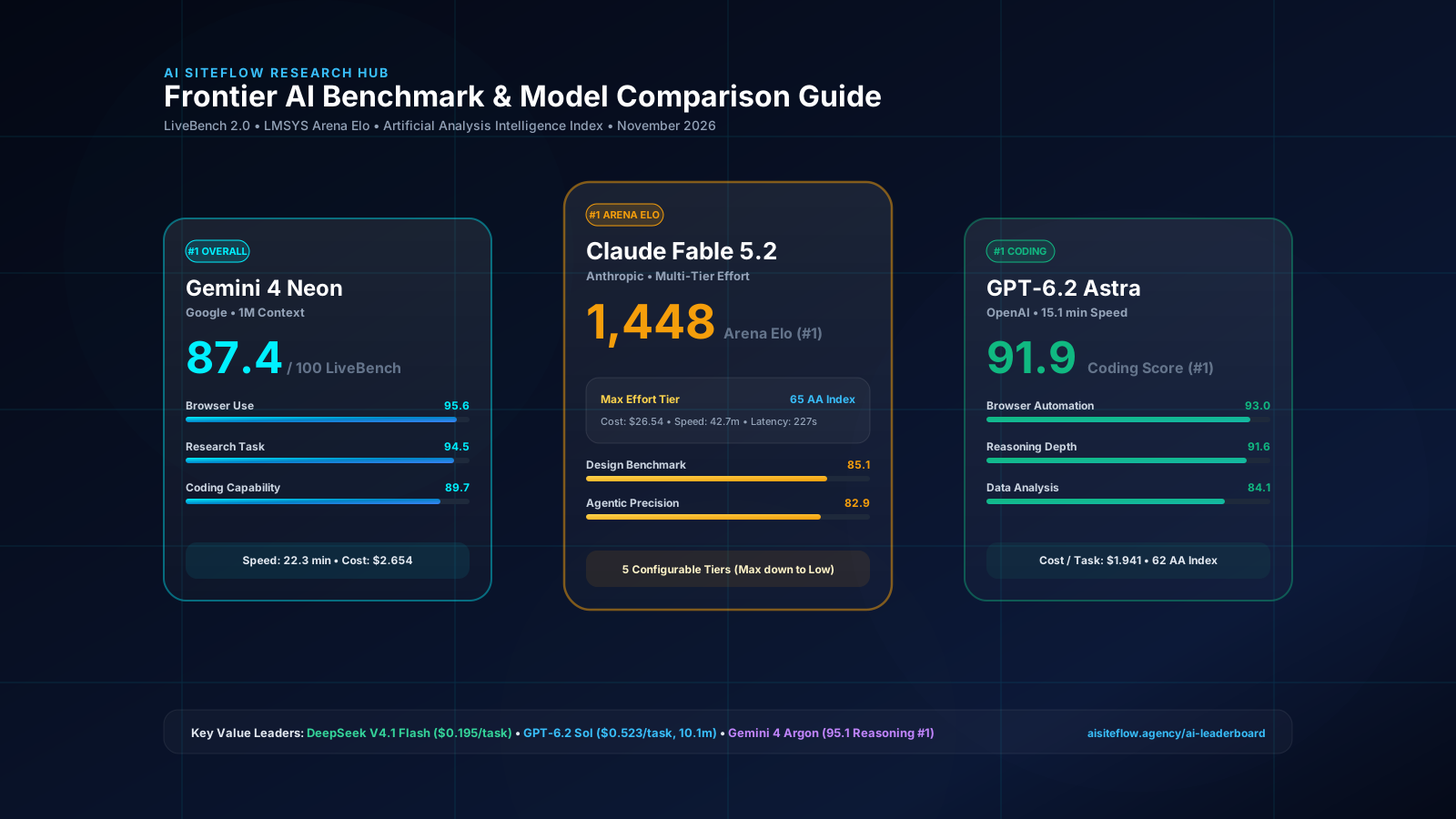
Frontier AI Model Leaderboard 2026: Comprehensive Benchmark Analysis, Speed, Cost & Architectural Comparison
An in-depth 2026 benchmark comparison across LiveBench 2.0, LMSYS Arena Elo, and Artificial Analysis. Discover why Gemini 4 Neon leads overall agentic workflows, Claude Fable 5.2 tops Arena Elo, and DeepSeek disrupts production unit economics.

AI Product Video Ads for Ecommerce in 2026: Turn One Product Photo Into Three Commercial Styles
Discover how ecommerce brands can turn one product photo into three cinematic AI video ad concepts, with production tips, examples, and creative strategies.
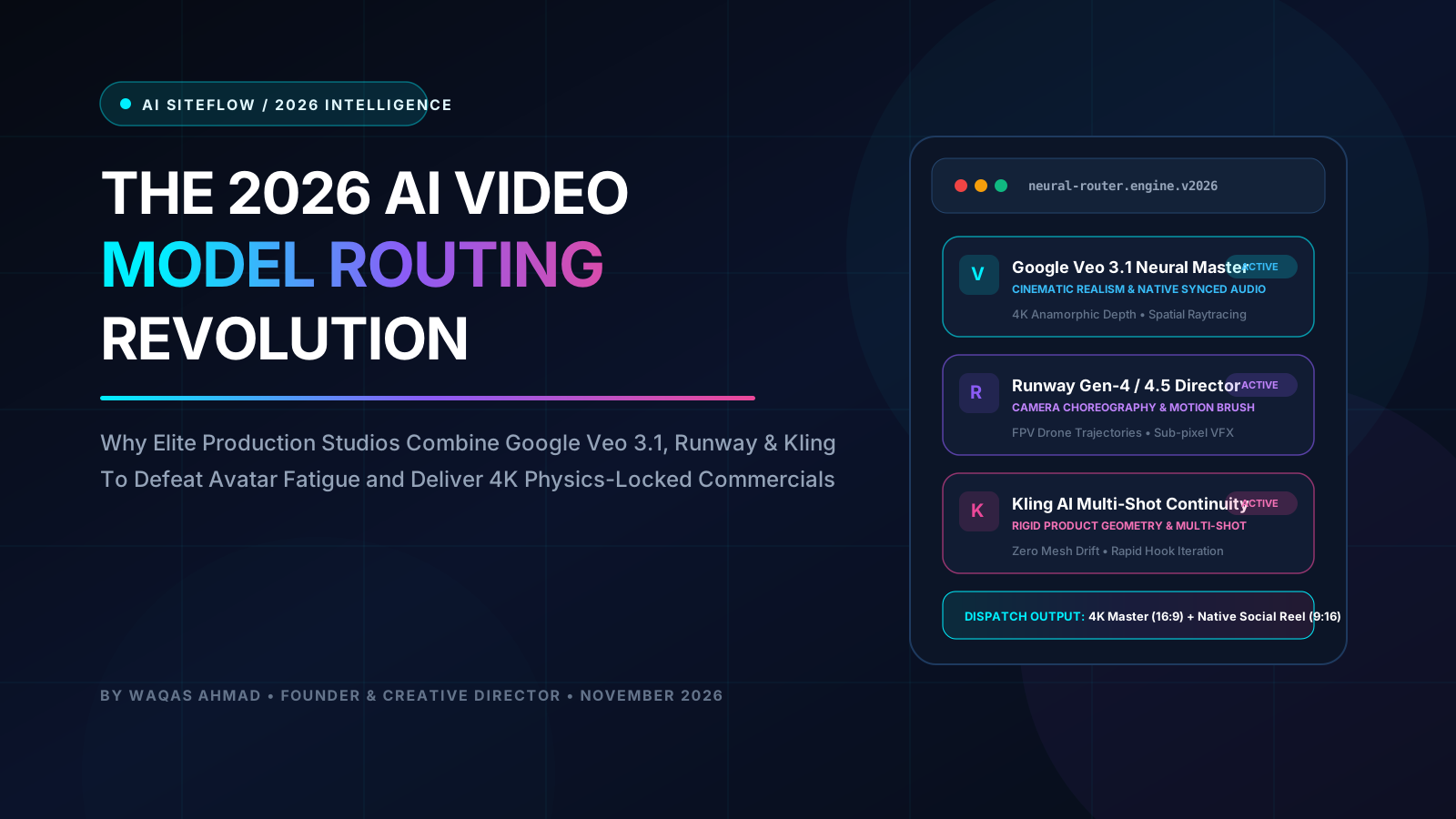
Today's AI Video Commercial Breakthrough (2026): Why Model Routing Replaces Cheap UGC Avatars with 4K Neural Cinema
Discover the late 2026 AI video breakthrough: why OpenAI's Sora exit reshaped ad production, how multi-model routing (Google Veo 3.1, Runway Gen-4 & Kling) defeats avatar fatigue, and how AI SiteFlow engineers 4K neural commercials.
Ready to Elevate Your Brand With AI Commercials?
From single high-impact commercial launches to full-scale monthly video pipelines. Explore our benchmark portfolio or commission your custom sprint today.