
How to Launch a High-Ticket B2B AI Automation Agency in 2026 Using KORTEX
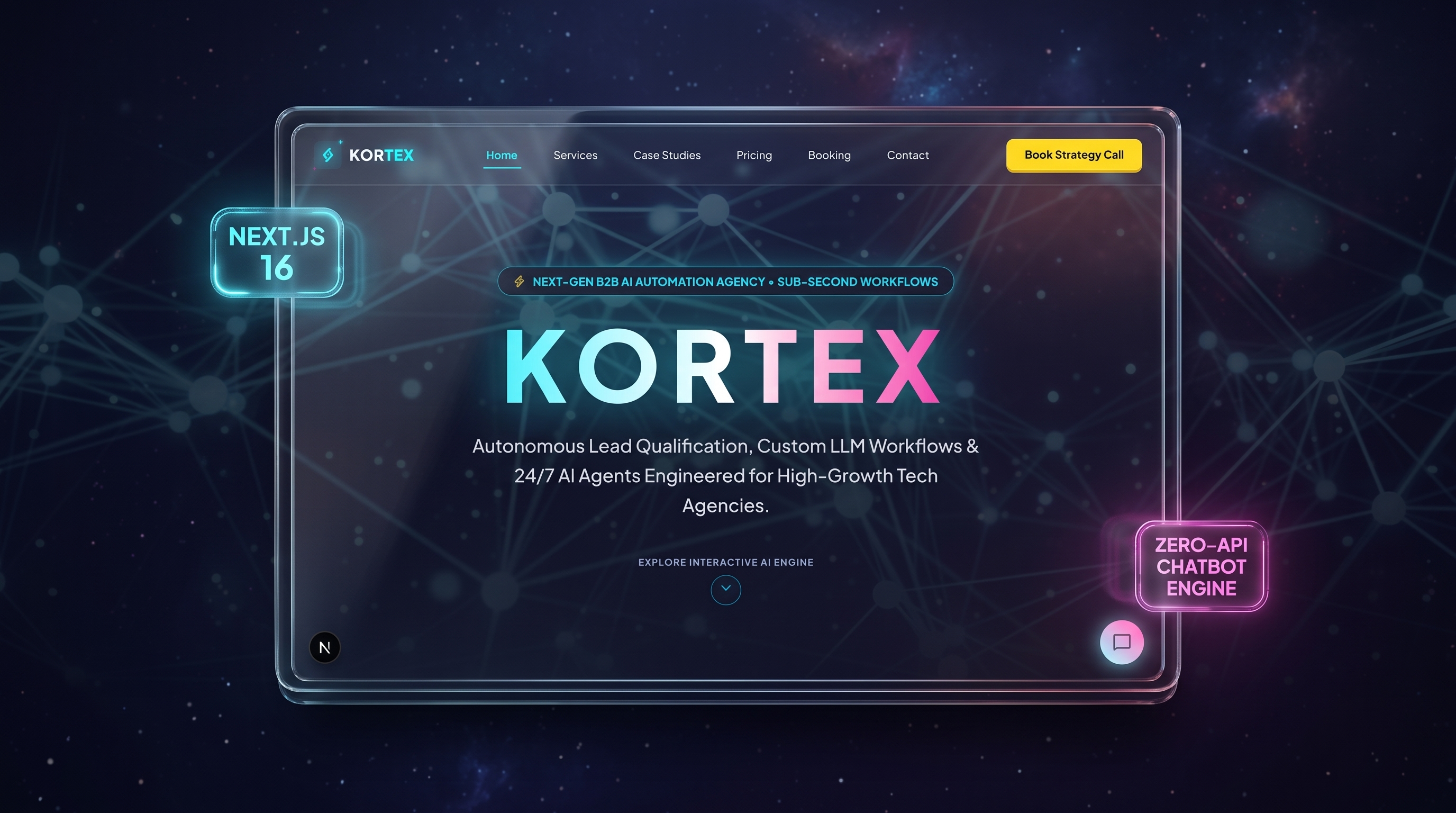
The global corporate transition toward autonomous operations has permanently disrupted standard digital agency business models. In 2026, mid-market enterprises, B2B SaaS corporations, private equity portfolio firms, and tech-forward logistics providers are no longer commissioning static marketing websites or cosmetic rebrands. Instead, executive leadership is allocating aggressive capital expenditures toward automated pipeline infrastructure: neuro-symbolic triage agents, autonomous CRM enrichment workflows, LLM-powered customer resolution engines, and real-time operational routing.
For founders, engineers, and technical consultants, this paradigm shift represents the most lucrative service arbitrage opportunity of the decade: the high-ticket B2B AI Automation Agency. Agencies operating on modern engineering stacks are consistently commanding upfront architectural setup fees of $10,000 to $25,000 paired with recurring monthly performance and optimization retainers between $5,000 and $15,000 per client.
However, the primary barrier preventing capable builders from scaling this business model is not technical delivery—it is authority, positioning, and digital conversion velocity. When selling enterprise-grade intelligence, presenting your firm via sluggish drag-and-drop website builders instantly destroys corporate credibility. In this comprehensive architectural masterclass, we break down the operational blueprint for launching, positioning, and scaling an elite B2B AI agency in 2026 utilizing KORTEX—the dark-mode Next.js 16 agency platform engineered specifically for autonomous services firms.
1. The B2B AI Automation Agency Landscape in 2026 ($10k/Month Retainer Model)
The modern AI agency model has evolved past simple ChatGPT prompt engineering and basic single-trigger Zapier integrations. Enterprise buyers in 2026 require end-to-end operational solutions that eliminate labor bottlenecks, reduce response latency from hours to milliseconds, and integrate natively into secure data environments.
The Shift from Commoditized Services to High-Value AI Workflows
Traditional digital marketing agencies are experiencing rapid margin collapse due to commoditization. In contrast, AI automation agencies focus exclusively on three revenue-critical operational pillars:
- Autonomous Front-Office Resolution: Deploying deterministic conversational agents capable of answering complex technical inquiries, checking inventory or database records via tool calling, and autonomously qualifying inbound leads.
- Back-Office Knowledge Retrieval (RAG): Indexing internal enterprise wikis, standard operating procedures (SOPs), and historical support tickets to provide employee-facing copilots that accelerate team throughput by 40–60%.
- Multi-Agent Workflow Orchestration: Connecting ERPs, CRMs (HubSpot, Salesforce), email gateways, and billing infrastructure into continuous, self-healing automation loops.
The $10,000/Month Retainer Economics
Under the high-ticket retainer model, an AI agency acts as an outsourced Chief Automation Officer (CAO) for mid-market companies. A typical enterprise engagement structure comprises:
| Service Level | Implementation Fee | Monthly Retainer | Scope of Work |
|---|---|---|---|
| Tier 1: Core Automation | $8,500 – $12,000 | $3,500 / mo | Customer triage agent, CRM sync, 1 core internal RAG workflow |
| Tier 2: Full Autonomous Ops | $15,000 – $25,000 | $7,500 / mo | 3 multi-agent pipelines, bi-weekly prompt fine-tuning, SLA monitoring |
| Tier 3: Enterprise Custom | $30,000+ | $12,500+ / mo | Dedicated private cloud LLM orchestration, continuous data vectorization |
With just 4 to 8 retainer clients, a lean agency operating with 1 to 3 engineers achieves $40,000 to $80,000 in high-margin Monthly Recurring Revenue (MRR).
2. Why Legacy WordPress & Webflow Templates Fail for AI Agencies
When corporate Vice Presidents of Technology, Chief Operating Officers, and Managing Directors evaluate an automation agency, their first interaction with your brand is your web infrastructure. Every subtle performance indicator acts as a proxy for your technical competence.
The Hidden Costs of Bloated Legacy CMS Platforms
Legacy website platforms fundamentally undermine the authority of an AI agency:
- Excessive DOM Depth and Third-Party Script Bloat: WordPress and Webflow stacks rely on dozens of injected plugins, heavy jQuery dependencies, and tracking wrappers. These dependencies degrade Time to Interactive (TTI) and First Contentful Paint (FCP), signaling to technical decision-makers that your team lacks fundamental software engineering discipline.
- Generic Aesthetic Fatigue: Corporate buyers see hundreds of white-and-purple SaaS templates every month. A generic template screams "reseller" rather than "cutting-edge artificial intelligence partner."
- Inability to Showcase Native Front-End Code: Modern AI buyers expect interactive, GPU-accelerated web experiences that respond smoothly at 60 to 120 FPS, featuring dark-mode neon glassmorphism, responsive tactile physics, and zero layout shift.
- Vendor Lock-in & Fragility: Plugin updates frequently break legacy forms and styling hooks, causing downtime that undermines client trust.
An enterprise automation firm requires clean, bespoke code that demonstrates mastery over modern edge web standards, sub-second latency, and deterministic UI state management.
3. KORTEX Technical Architecture (Next.js 16, React, Tailwind CSS, Zero-API Client Engines)
KORTEX was engineered from the ground up to serve as the ultimate web foundation for autonomous agencies. It eliminates weeks of UI/UX design, performance optimization, and front-end scaffolding by delivering a production-grade codebase built on current 2026 web standards.
┌─────────────────────────────────────────────────────────────┐
│                    KORTEX ARCHITECTURE                      │
├─────────────────────────────────────────────────────────────┤
│  Next.js 16 (App Router + Turbopack)                        │
│  ├── React 19 Server & Client Components                    │
│  ├── Tailwind CSS v4 Engine (Zero-Runtime Styling)          │
│  ├── Framer Motion GPU Compositing Pipeline                 │
│  └── Client-Side Interactive Micro-Engines (Zero API Cost)  │
└─────────────────────────────────────────────────────────────┘
Next.js 16 Turbopack & Static Edge Optimization
KORTEX harnesses the Next.js 16 App Router paired with the Turbopack bundling engine. By generating lightweight, pre-rendered static assets served across edge CDNs, KORTEX ensures sub-second page loads worldwide:
- Zero CLS (Cumulative Layout Shift): Rigid CSS grid and flexbox scaffolding prevent jarring jumps during asset hydration.
- Native Font Optimization: Leveraging
next/fontwith Plus Jakarta Sans avoids render-blocking external Google Fonts network calls. - Edge Deployment Ready: Instant compatibility with global edge infrastructures like Vercel and Netlify.
Zero-API Client Engines: Zero Server Bills, 100% Reliability
One of KORTEX's greatest technical innovations is its Zero-API Interactive Engine Architecture. Most template demos require external OpenAI or Anthropic API keys to demonstrate conversational capability. This creates two fatal vulnerabilities:
- Malicious visitors can drain your API token balance with automated scraping loops.
- If the external LLM provider experiences latency spikes or outages, your primary sales vehicle fails live in front of prospects.
KORTEX solves this by implementing zero-cost client-side simulation engines. The conversational concierge uses deterministic state machines with naturalistic typing delays (800ms–1500ms) and multi-turn branching logic. Prospects experience an instantaneous, immersive AI chat demonstration without your agency incurring a single cent in inference costs.
4. Deep Dive into Core KORTEX Components
The KORTEX architecture is composed of specialized, high-conversion component modules designed to escort prospects through a deterministic sales narrative.
Component A: Interactive Zero-API Lead Qualification Engine
Located in both the hero fold (HeroChatbot.tsx) and as a persistent floating concierge (FloatingChatbot.tsx), this component qualifies visitors in real time:
// Deterministic typing simulation and conversational state machine
const handleQuestionClick = (question: string) => {
  if (isTyping) return;
  const userMsg: ChatMessage = {
    id: `user-${Date.now()}`,
    role: "user",
    content: question,
  };
  setMessages((prev) => [...prev, userMsg]);
  setIsTyping(true);

  // Natural humanized typing cadence simulation
  const delay = 800 + Math.random() * 500;
  setTimeout(() => {
    const response = responses[question] || defaultResponse;
    const botMsg: ChatMessage = {
      id: `bot-${Date.now()}`,
      role: "bot",
      content: response.text,
      action: response.action,
    };
    setMessages((prev) => [...prev, botMsg]);
    setIsTyping(false);
  }, delay);
};
This interactive pattern answers common enterprise questions instantly and routes high-intent buyers directly to the strategy call booking form.
Component B: Real-Time Client ROI & Operational Cost Savings Calculator
Corporate executives approve budgets based on quantifiable cost reduction and pipeline acceleration. KORTEX integrates an interactive financial modeling card that allows prospects to adjust employee headcounts, manual hourly task burdens, and average loaded labor rates:
Monthly Operational Savings = (Team Headcount × Hours Spent on Repetitive Tasks × Hourly Labor Cost) × Automation Efficiency Rate (75%)
By sliding the parameters to match their team, decision-makers visually discover that your $10,000 implementation will save their organization $180,000+ in annual overhead, rendering your fee an undeniable mathematical bargain.
Component C: High-Converting Enterprise Case Studies Layout
Case studies are the ultimate conversion accelerants. The KORTEX case study framework shifts away from vague testimonial quotes toward hard operational metrics:
- Baseline Metric: Before automated implementation (e.g., 42-hour ticket response time).
- Architectural Solution: The multi-agent workflow deployed.
- Quantified Result: 94% autonomous ticket closure rate with an 8-minute average resolution window.
5. Step-by-Step Deployment Guide (Extract, Install, Host)
Deploying KORTEX takes under 10 minutes and requires zero complex DevOps configuration:
Step 1: Extract the Repository
Download and unpack the KORTEX distribution package into your local workspace:
unzip kortex-template.zip -d ./kortex-agency
cd ./kortex-agency
Step 2: Install Clean Dependencies
Ensure you are running Node.js 20 LTS or Node.js 22. Install peer dependencies:
npm install
Step 3: Configure Agency Branding & Booking URLs
Open src/app/layout.tsx and configure meta tags. In kortex.css, customize brand color tokens. Route book/page.tsx to your Cal.com or Calendly URL.
Step 4: Validate Production Build Locally
npm run build
Step 5: One-Click Edge Deployment
Push your repository to GitHub and connect to Vercel. Framework preset is automatically detected as Next.js. Deploy in under 45 seconds.
6. Monetization Strategy & $29 LemonSqueezy Template Licensing Integration
For developers and creators who wish to offer agency template licensing, KORTEX provides out-of-the-box integration with LemonSqueezy, the merchant-of-record platform of choice for digital goods in 2026.
Why LemonSqueezy for Digital Agency Products?
LemonSqueezy handles global tax compliance, VAT collection, EU digital goods regulations, automated receipt generation, and fraud prevention without requiring you to establish multiple international merchant accounts.
1-Click Checkout Button Integration
Connecting your checkout funnel is effortless. KORTEX provides clean button hooks across cards, detail views, and sticky banners:
const LEMONSQUEEZY_CHECKOUT_URL = "https://aisiteflow.lemonsqueezy.com/checkout/buy/f8544d74-c5dd-4c04-a901-ce14de4554ea";

export default function PurchaseButton() {
  return (
    <a
      href={LEMONSQUEEZY_CHECKOUT_URL}
      target="_blank"
      rel="noopener noreferrer"
      className="inline-flex items-center justify-center px-8 py-4 rounded-xl bg-gradient-to-r from-[#00F0FF] to-cyan-400 text-slate-950 font-extrabold text-sm uppercase tracking-wider shadow-[0_0_25px_rgba(0,240,255,0.4)] hover:scale-[1.03] transition-all"
    >
      BUY TEMPLATE ($29)
    </a>
  );
}
By decoupling your sales flow between high-ticket agency services ($10k retainers) and productized developer templates ($29 licenses), you diversify your revenue streams and build an inbound pipeline of future agency clients.
7. Closing $5,000 Client Retainers via Cold Outreach & Live Interactive Demos
The greatest advantage of having KORTEX deployed live on your domain is how it revolutionizes your outbound sales conversions.
The "Interactive Video Proof" Outreach Framework
Standard cold emails containing generic pitch decks achieve less than 2% response rates. Modern executives ignore pitch decks. Instead, execute this 3-step high-converting sequence:
- Identify High-Pain Corporate Bottlenecks: Target mid-market companies (50 to 500 employees) in logistics, healthcare staffing, legal services, or B2B SaaS that are actively hiring customer support reps or manual operations coordinators.
- Record a 60-Second Custom Loom Video: Open your live KORTEX website on screen. Show their executive team the interactive concierge bot: "Hey [Name], I noticed your team is scaling customer operations with 4 headcount. Instead of burning $240k/year, we engineered an autonomous workflow resolving 80% of inquiries in 4 seconds. Here is a live simulation on our agency platform..."
- Provide a Direct One-Click Booking Link: Direct the executive straight to your KORTEX
/bookscheduling page. Perceived value jumps tenfold before you even enter the discovery call.
Conclusion: Take Command of Your Agency Presence
In 2026, the winners in the AI agency space will not be the loudest marketers—they will be the teams with the highest technical execution standards, cleanest front-end architecture, and most compelling interactive digital assets.
By leveraging KORTEX, you skip 80+ hours of custom development and position your agency as an elite enterprise automation partner from Day 1. Explore the live demo and license KORTEX today on AI SiteFlow.